Songkran in Chiang Mai 2027: the honest guide
Three days, one city-wide water fight, and nobody stays dry. How Songkran works in Chiang Mai, where it hits hardest, what to buy, and why we'd rather you walked.
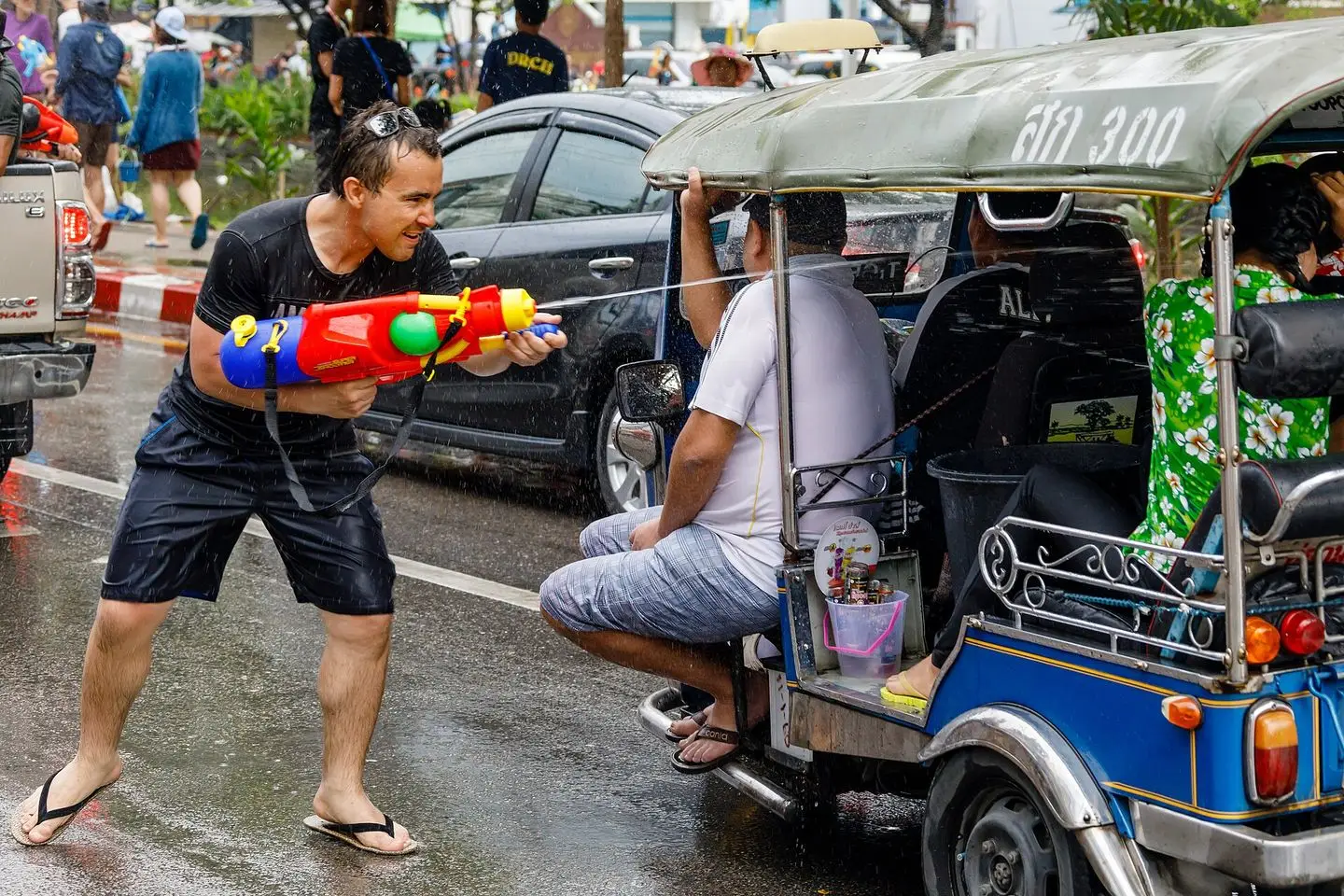
Photo: CEphoto, Uwe Aranas / Wikimedia Commons (CC BY-SA 4.0)
If you have never been in Thailand for Songkran, fix that. For three days in the middle of April the whole country stops and has a water fight — grandmothers with garden hoses, kids with buckets, pickups cruising past with a barrel in the back and six people ladling it onto whoever they pass. It's Thai New Year, it's the hottest week of the year, and it is, honestly, one of the best things you can be in the middle of. Anywhere in Thailand will do. Chiang Mai just does it bigger than anywhere else.
In 2027 it falls on Tuesday 13 to Thursday 15 April, with the city warming up from the weekend before. Here's how the three days actually work, where it hits hardest (the moat, and Nimman), what to buy, what not to do — and, because we rent scooters for a living, an honest word about the roads.
New year, by water
Songkran is the old Thai New Year — the day the sun moves into Aries, which is why it sits on 13 April every year instead of drifting with the moon like Loy Krathong. Water is the whole point. You pour it over Buddha images to bathe them, over your elders' hands to ask for their blessing, and — originally — a polite trickle over everyone else's shoulder to wash off the old year's bad luck. The polite trickle is what turned, somewhere along the way, into a nationwide water fight.
Up here it's called Pi Mai Mueang, the Lanna New Year, and Chiang Mai — which has been doing this since it was the capital of its own kingdom — takes both halves seriously: temples and elders in the mornings, carnage in the afternoons. UNESCO put Songkran on its intangible heritage list in 2023, which tells you it's more than a street party, even when it doesn't look like it.
The three days (and the ones around them)
The public holidays are 13, 14 and 15 April — Tuesday to Thursday in 2027 — but the north counts them its own way, and each day has a job:
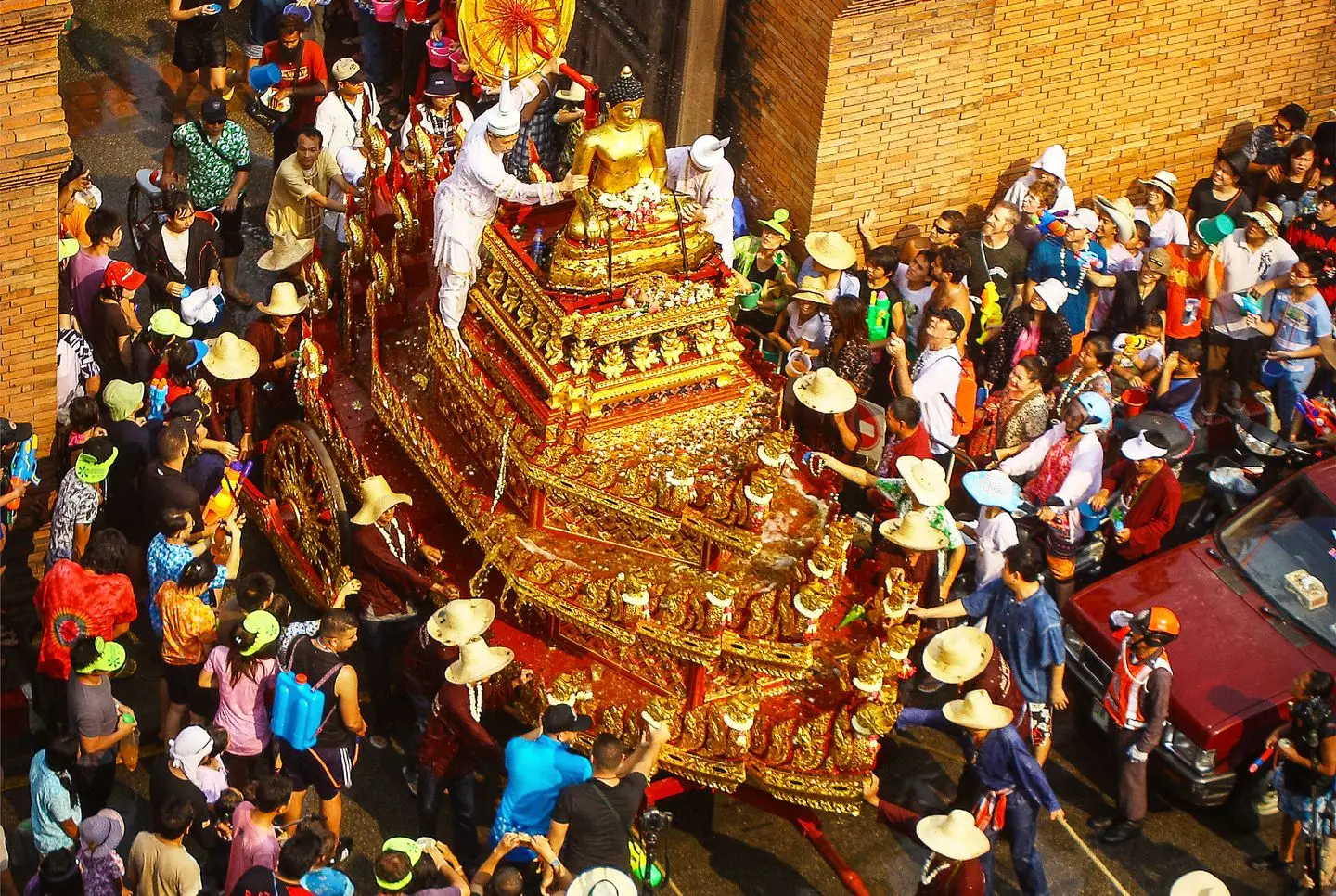
- 13 April — Wan Sangkhan Long. The old year leaves. Traditionally you set off a firecracker at dawn to chase the bad luck out, clean the house, wash your hair and put on new clothes. In Chiang Mai it's also the big ceremonial day: alms for the monks at Tha Phae Gate at seven, the official opening, and in the early afternoon the procession of Phra Buddha Sihing — the city's most revered image — carried from Nawarat Bridge along Tha Phae Road, through the gate and up Ratchadamnoen to Wat Phra Singh, with the crowd showering it in scented water as it passes; it then sits on an altar outside the temple for three days so people can bathe it. It is also, not by coincidence, the biggest day of the water fight.
- 14 April — Wan Nao. The day in between. You're not supposed to swear or argue (bad luck for the whole year), and in the afternoon families carry sand to their temple to build little sand pagodas — paying back the dirt they've carried out on their feet all year. Watch for the sand-carrying procession down Tha Phae Road. Still a full-strength water day.
- 15 April — Wan Phaya Wan. The actual New Year's Day. Early alms, Buddha images bathed in scented water, paper flags planted on the sand pagodas, and in the afternoon dam hua — pouring perfumed water over the hands of parents, grandparents and teachers. The street fight is still going, but thinning.
- 16 April — Wan Pak Pi. The “mouth of the year”. Mostly family rites, and in Chiang Mai a last afternoon of die-hards around the moat.
In practice the city doesn't wait for the 13th. The municipality's programme runs for about ten days around the holidays (6–17 April in 2026; the 2027 schedule gets announced in late March), and by the Sunday before, the moat is already soaked and the pickups are already circling. If you want the full dose, be here 12–15 April. If you want to see it and still get a dry day out of the trip, the afternoon of the 15th and the 16th are gentler.
Where it hits hardest: the moat, Tha Phae Gate and Nimman
Two places, really. Everything else is a satellite.
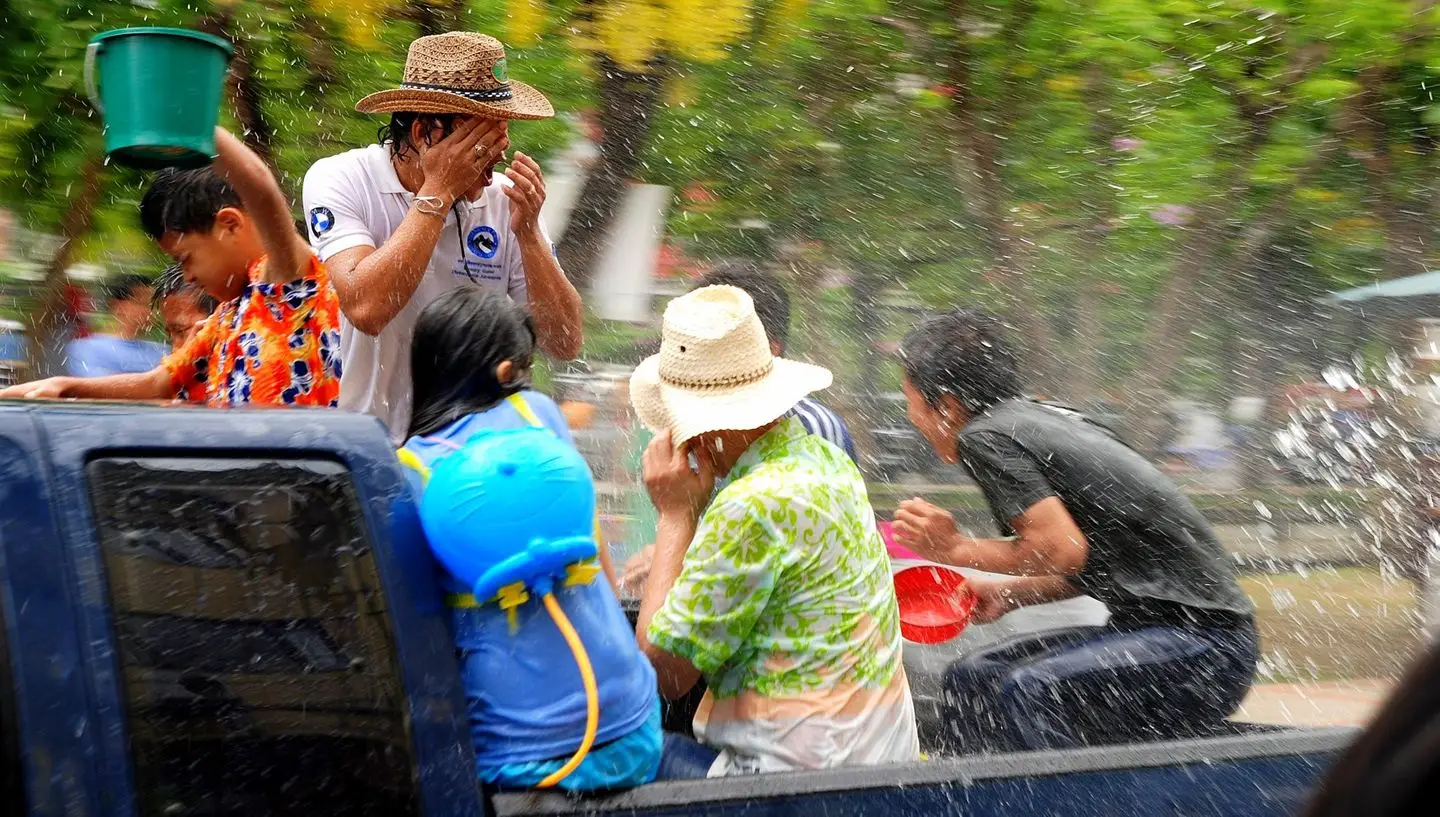
The Old Town moat. This is the heart of it, and the thing that makes Chiang Mai's Songkran different from anywhere else in the country. The Old Town is a square, ringed by a moat with a one-way road along each side — so the fight has a built-in racetrack. Pickups with a barrel in the back and a crew of six drive that square round and round, all day, in a jam that never clears, lobbing water at the pavement; the pavement — hundreds of people deep, every bar, every family with a hose — gives it straight back. The moat itself is the ammunition: people dip buckets into it over the railings, and vendors sell blocks of ice to drop in. Tha Phae Gate on the east side is the main stage, with the ceremonies in the morning and performances at night, and for the last three years the municipality has closed Tha Phae Road on the evenings of 13–15 April for a 130-metre water tunnel with DJs — clean municipal water, until midnight. Midday to about four is peak time on the moat. By five it's colder, dirtier and drunker, which is a good moment to go and get dry.
Nimmanhaemin. The second centre, and the party one. One Nimman, the Maya mall plaza and Think Park at the Huay Kaew junction run stages from about the 11th to the 15th — DJs, water cannons, a pool party with a slide at One Nimman — and the road itself, normally all coffee shops and students, turns into one long wet block party that keeps going into the night long after the moat has gone quiet. If the moat is the whole city, Nimman is where the under-30s end up. Think Khao San Road, Chiang Mai edition.
The satellites: the Night Bazaar and Chang Khlan Road (more hotels, a bit more Bangkok), the Central malls with their own stages, and Zoe in Yellow doing what it always does, wetter. For the calm side, Wat Phra Singh and Wat Chedi Luang on the mornings of the 13th and 15th — Buddha images being bathed, monks, elders, sand pagodas. Cover your shoulders and knees, leave the water gun at the gate, and you'll see what the festival was before it became a fight.
You will not stay dry
Let's be clear about this, because people arrive thinking they can pick their moments. You can't. Step out of the hotel for a coffee and someone's kid gets you from a doorway. Ride a scooter across town and you'll take a bucket at every red light — people wait for you to stop, and that counts as a courtesy. Sit in the back of a songthaew and water comes in through the window. Walk the moat for ten minutes and you're wet to the skin and staying that way until you shower. From about ten in the morning until dark on 13–15 April, the only dry places in Chiang Mai are indoors.
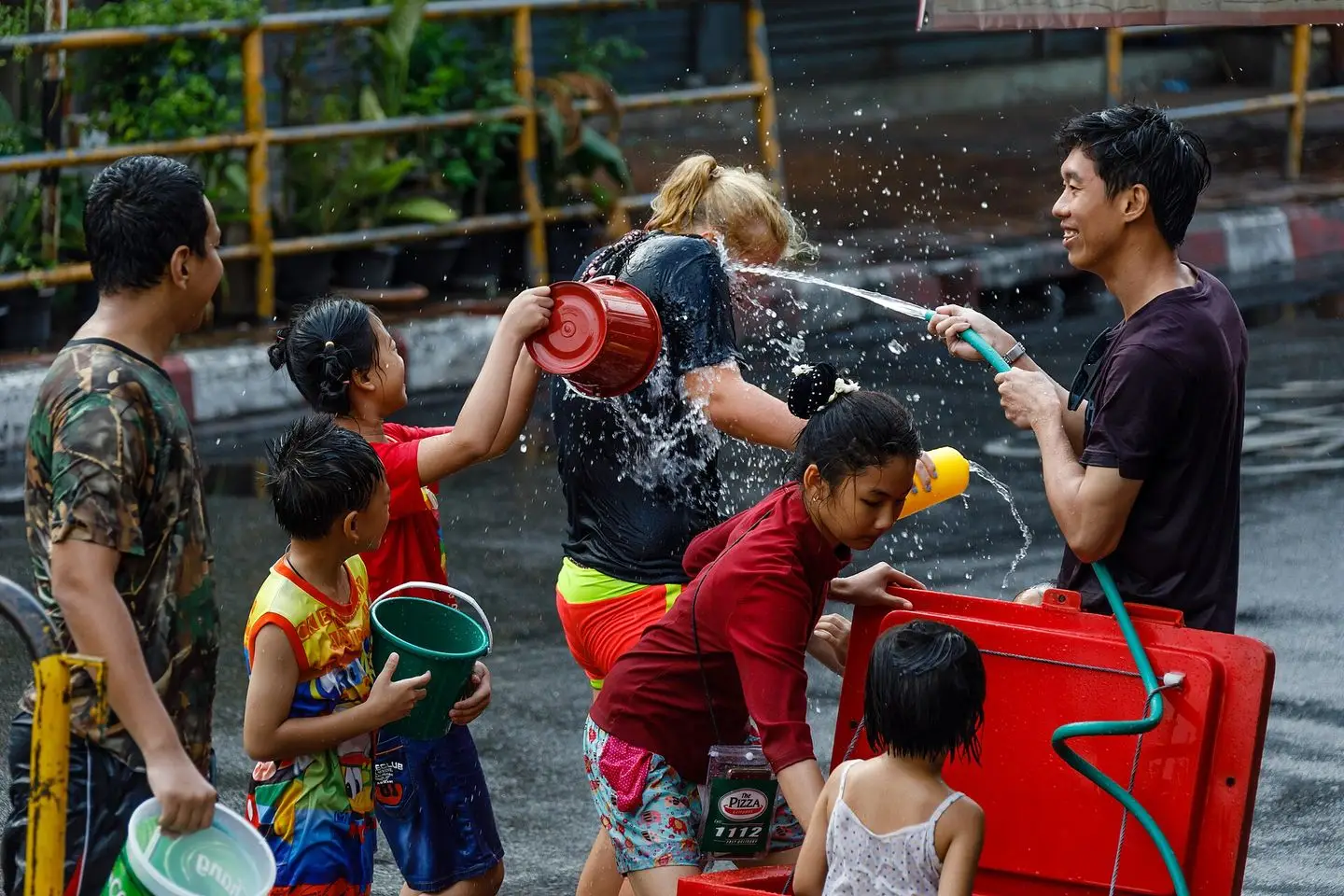
So dress for it: quick-dry shorts, a dark T-shirt (white turns see-through in seconds — and a loud flowery shirt is the local uniform anyway), sandals you can actually walk in, and nothing you'd mind losing. Phone in a waterproof pouch (every stall sells them, ฿20–100 — test it with a tissue first), cash in a zip-lock inside the pouch, and your passport, cards and anything with a battery back at the hotel. Contact lenses out: the water will get in your eyes whatever you do, and that is exactly how post-Songkran conjunctivitis happens. Cheap swimming goggles are not a silly idea, and nobody will laugh. And if you genuinely need to get somewhere dry, a raised hand and “mai len nam” (not playing) works — mostly.
Choosing your weapon
You don't need to bring anything. From about a week before, every 7-Eleven, every market and every third metre of pavement around the moat sells water guns — from about ฿50 for a toy, ฿150–300 for a decent pump-action one, up to ฿600 for the big backpack tanks — plus buckets, dippers and the pouches. The humble bucket is still the most effective thing out there: more water, instant reload, and it's what the Thais use.
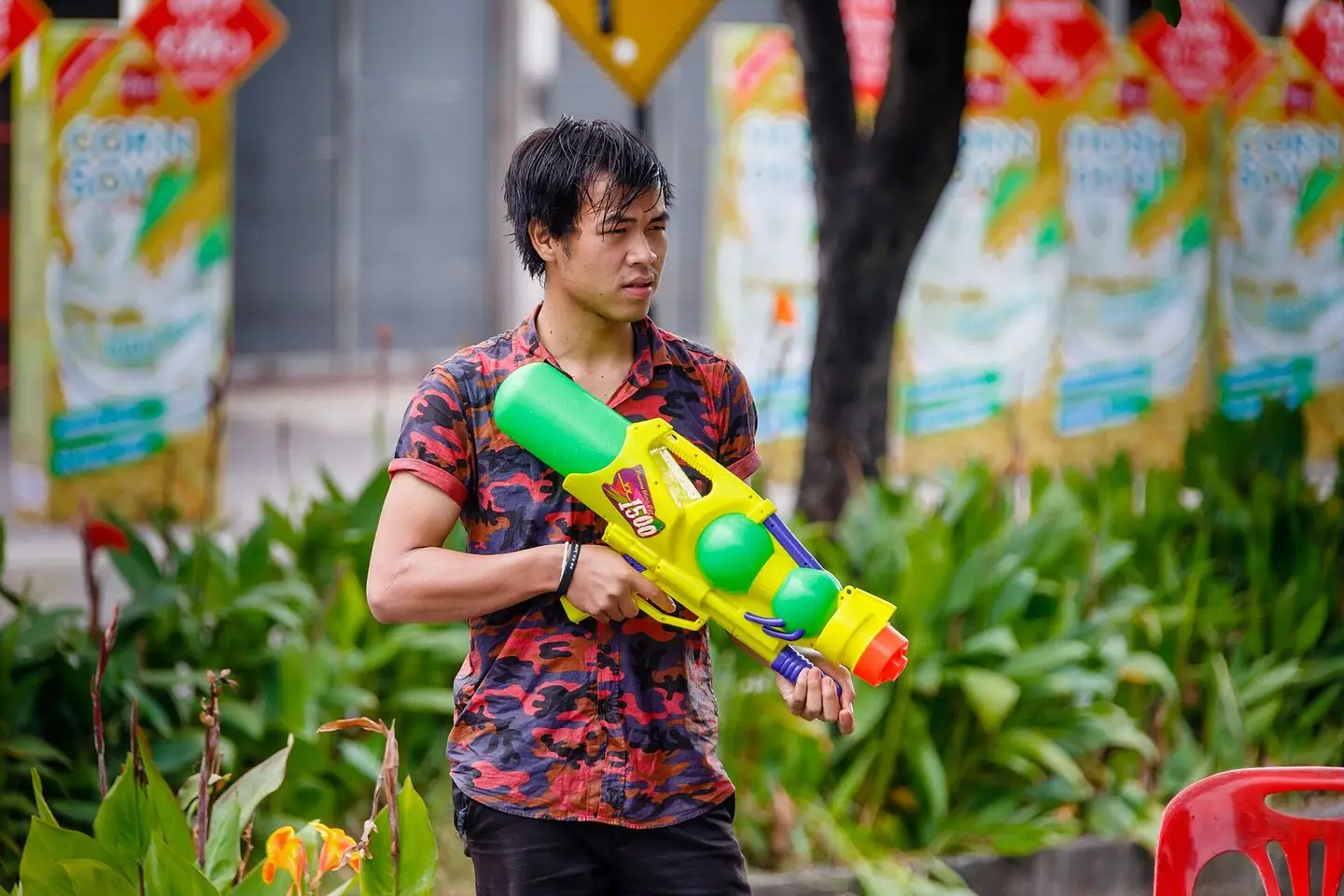
If you want something better than stall grade — a pump that actually holds pressure, a tank that doesn't split on day two — order it a week or more ahead on Shopee or Lazada. The choice is ten times bigger, prices are lower, both run Songkran sales in early April, and delivery to a Chiang Mai hotel takes a few days. One rule: no high-pressure guns and no home-made PVC cannons. They're illegal (up to two years or a ฿4,000 fine), they get confiscated at the moat, and they take people's eyes out.
Refills: dip in the moat like everyone else (free — see the next section), or use the barrels the bars put out front and the clean-water dispensers that have appeared along the moat roads in recent years if you'd rather not. Be the person with the clean water.
The unwritten rules
- Not in the face. Aim at the body. A face full of water from two metres hurts, blinds people for a second, and if they're on a bike or a bicycle it's dangerous. Shoulders and backs are plenty.
- Think about where the water came from. The moat is refilled and chlorinated before the festival and the municipality tests it the week before; the official line every year is “fine to splash, don't drink it”. In practice it's river water that a few thousand people, a few hundred pickups and the odd dog have been in all day — a university check in 2015 found parasites in the sediment. Mouth closed, eyes shut, shower afterwards. Red, stinging eyes two days later is conjunctivitis; every pharmacy knows the drill.
- Go easy on the ice. Vendors along the moat sell blocks of it to drop in your barrel, and a bucket of near-freezing water across the back on a 38-degree afternoon is a genuine shock — unpleasant for anyone, awful for kids and old people, and ice cubes flung along with the water have put people in hospital. Police have banned ice outright in previous years. Cold is fine. Ice is just mean.
- No powder, no paint. Smearing wet talc on faces is an old tradition that got hijacked; it's banned in the official zones, and ฿5,000 if you do it to anyone who didn't agree.
- Pick your targets. Not monks. Not babies, not the very old, not anyone in office clothes or carrying shopping, not anyone who says no. And not anyone on a moving motorbike — more on that below.
- The moat roads are dry. The province has banned alcohol on the moat roads and at the big venues most years, and the moat was an official alcohol-free zone again in 2026. Bars stay open; the pavement doesn't, and don't drink anything passed down from a pickup — you don't know what it was mixed with. Also: a bikini is not a Songkran outfit — ฿5,000, and the looks you get will be the wrong kind.
- Say it. Sawasdee pi mai — happy new year. Say it as you soak someone and they'll beam at you.
The traffic: everything crawls
Plan for it. For five days the moat ring is a slow-moving parade of pickups, so anything that needs to cross the Old Town or go round it takes an hour. Tha Phae Road is closed to traffic in the evenings, the Huay Kaew junction by Nimman is chaos, and the main roads out of town are full of half of Thailand driving home to their families. Grab takes ages to arrive, costs more, and drivers cancel when they see you're dripping. Songthaews steer clear of the moat. The airport is a quarter of an hour from the Old Town normally; in Songkran week give it an hour, and don't book a flight that depends on the two o'clock you had in mind.
What works: stay within walking distance of where you want to be — which is why the Old Town and Nimman hotels near the action fill up first and get pricier, so book a couple of months ahead. Park the scooter a few sois back and walk the last bit. Move early in the morning, before it all starts. And accept that the “quick errand” doesn't exist on 13–15 April.
A word about the roads, because we rent scooters
This is the part nobody puts in the brochure, so here it is straight: Songkran is the deadliest week of the Thai year. In the official “seven dangerous days” around Songkran 2026 (10–16 April), 242 people died on Thailand's roads and another 1,200 were injured in 1,242 crashes — roughly two-thirds of them involving motorcycles, speeding and drink-driving the top causes, and the evening between six and nine the worst hours. 2025 was 253 dead; 2024 was 287. Chiang Mai province officially counted 11 serious crashes and 5 deaths in 2026, and had more drink-driving probation cases than anywhere else in Thailand — 757 of them, more than twice Bangkok's.
Then add the festival itself: a bucket of water in the face at 50 km/h, painted road lines with no grip when wet, powder slurry on the tarmac, drivers who've been drinking since lunch, and people stepping into the road to aim at you. Riding through Songkran is not like riding in Chiang Mai on the other 360 days of the year, so our honest advice, from people who'd rather you came back next year:
- Helmet, always — and your passenger's too. It's ฿2,000 each without one, but more to the point, 84% of the riders who end up in Thai hospitals weren't wearing one. A full-face with the visor down also stops the bucket.
- Zero alcohol before you ride. The legal limit is 50 mg%, and only 20 mg% — one small beer, if that — if you're under 20 or don't hold a valid motorcycle licence, which is most tourists (here's where you stand on licences). Checkpoints are everywhere during Songkran, and refusing the breath test counts as failing it.
- Don't ride the moat ring in the afternoon. Nothing you need is worth it. Walk.
- Ride slow, ride early, don't ride after dark. Half speed, both hands on the bars, double the distance, and treat every stopped pickup as a bucket about to be thrown. Mornings before ten are dry and calm; the evenings are when the crashes happen.
- Expect to be stopped and soaked. People wait for riders to pull up at the lights. Stop, smile, take it, and ride on when you can see again. Never accelerate out of it.
- If you don't need to ride on 13–15 April, don't. Keep the bike for the day trips before and after — the city on those three afternoons is for feet. Our road safety guide covers the rest of the year.
If you're renting with us, the bike arrives at your door, so you're not picking it up in the middle of it — and we'd honestly rather you booked it for the ride up to Pai the week after than for the moat on the 13th. The range and prices are here.
Heat, smoke and the other stuff
April is the hottest month of the year in Chiang Mai — 37°C is a normal afternoon and 40 isn't unusual — which is a large part of why the water fight exists at all. Drink water constantly (the beer doesn't count), get out of the sun in the early afternoon, and if you stop sweating, that's heat stroke: find air-conditioning now.
The less fun truth is that Songkran also falls at the tail end of the north's burning season. Most years the air is improving by mid-April; in 2026 it wasn't — Chiang Mai was declared a disaster zone on 4 April, topped the world's most-polluted list a few days later, and was still “unhealthy” on the last day of the festival. Check the AQI (IQAir or Air4Thai) before you book, pack a proper N95 for the mornings if it's bad, and don't count on the festival rain to clear it — the real rains don't arrive until late May.
Practical stuff, honestly
Hotels: book a couple of months ahead; Old Town or Nimman if you want to walk everywhere, a few streets back from the moat if you want to sleep. Shops: government offices and plenty of small businesses close 13–15; malls, 7-Elevens and anyone selling water guns stay open. Cash: ATMs run dry before long weekends, so stock up on the 11th. Kids: brilliant, honestly — the Tha Phae Gate area is car-free in the evenings and the One Nimman pool party was built for them, but keep them out of the ice crossfire and off the moat railings. Mornings are the gentle version: temples, sand pagodas, the procession. Photos: a cheap waterproof camera beats a phone in a bag.
Last thing: it's New Year before it's a water fight. Go to a temple on the morning of the 15th, pour a little scented water over a Buddha, let an old lady pour some over your hands, and you'll understand why Thais get misty-eyed about Songkran. Then go and get soaked.
Quick questions
When is Songkran 2027 in Chiang Mai?
The public holidays are Tuesday 13 to Thursday 15 April 2027. Chiang Mai's own programme runs for about ten days around them (6–17 April in 2026) and the moat water fight starts in earnest on the Sunday before, 12 April, then winds down through the 15th and 16th. The city announces the exact schedule in late March.
Where is the best place to celebrate Songkran in Chiang Mai?
The Old Town moat and Tha Phae Gate for the full, whole-city version — pickups circling the square, the stages, the evening water tunnel on Tha Phae Road — and Nimmanhaemin (One Nimman, Maya, Think Park) for the party. Wat Phra Singh and Wat Chedi Luang in the mornings for the traditional side.
Can you stay dry during Songkran?
No. From mid-morning until dark on 13–15 April you'll be soaked within minutes of stepping outside, on foot or on a bike — people wait for riders to stop at the lights. Dress for it, keep your phone in a waterproof pouch and leave the passport at the hotel.
Is the moat water safe?
Officially yes for splashing and no for drinking: the city refills and chlorinates the moat before the festival and tests it the week before. It's still river water that thousands of people have been in all day, so keep your mouth and eyes closed, take contact lenses out, shower afterwards and see a pharmacist if your eyes are red two days later.
Where do I buy a water gun in Chiang Mai?
Any stall, market or 7-Eleven in the week before — they're everywhere around the moat, from about ฿50 for a toy to ฿600 for a backpack tank. For something that will last all three days, order on Shopee or Lazada a week or more ahead. High-pressure guns and PVC cannons are illegal and get confiscated.
Can I ride a scooter during Songkran?
You can, but ride like it's a different city: helmet on, zero alcohol (the limit is only 20 mg% if you don't hold a valid motorcycle licence), half speed, mornings only, nowhere near the moat ring in the afternoons and never after dark. Expect to be soaked at every red light — stop and take it. Songkran is Thailand's deadliest week on the roads, and around two-thirds of the crashes involve motorcycles.
Is Songkran in Chiang Mai good for kids?
Very — it's the most kid-friendly festival in Thailand. Stick to the mornings and the car-free Tha Phae Gate area, keep them clear of the ice-heavy pickups on the moat, and the One Nimman pool party was practically built for them.