Scooter or car in Chiang Mai? An honest comparison
Parking, traffic, day trips, the long haul to Pai or Chiang Rai, rain, kids, licences and real costs: a scooter rental's honest comparison, including the cases where a car is the right call.
We rent scooters, so you can guess which way we lean. Here is the honest version anyway. For most people who come to Chiang Mai alone or as a couple, a scooter is the better choice: it parks anywhere, it costs a fraction of a car, and the roads people come here for, up Doi Suthep, out to Mae Kampong, over the mountains to Pai, are better on two wheels. For some trips and some travellers a car is the right call, and pretending otherwise would put you on the wrong vehicle. A family with small children, a week of September rain, a run to Chiang Rai, a first-ever ride in traffic: car.
Below is the decision by situation, with the numbers and the licence and safety facts most comparisons skip.
Getting around the city
Chiang Mai is small. The Old Town is a 1.5 km square, Nimman is ten minutes west of it, and almost everything a visitor wants is inside a 5 km circle. That geography is what makes the scooter work here.
The roads inside that circle were not built for cars. The Old Town is a grid of lanes (sois) a car and a half wide, many of them one-way. The two roads along the moat run one-way in opposite directions, the outer clockwise and the inner anticlockwise, and you change sides through U-turn gaps at the bridges; miss your gap in a car and you go round again. On a scooter you shrug and turn at the next one. Nimman is the same story with more cafés.
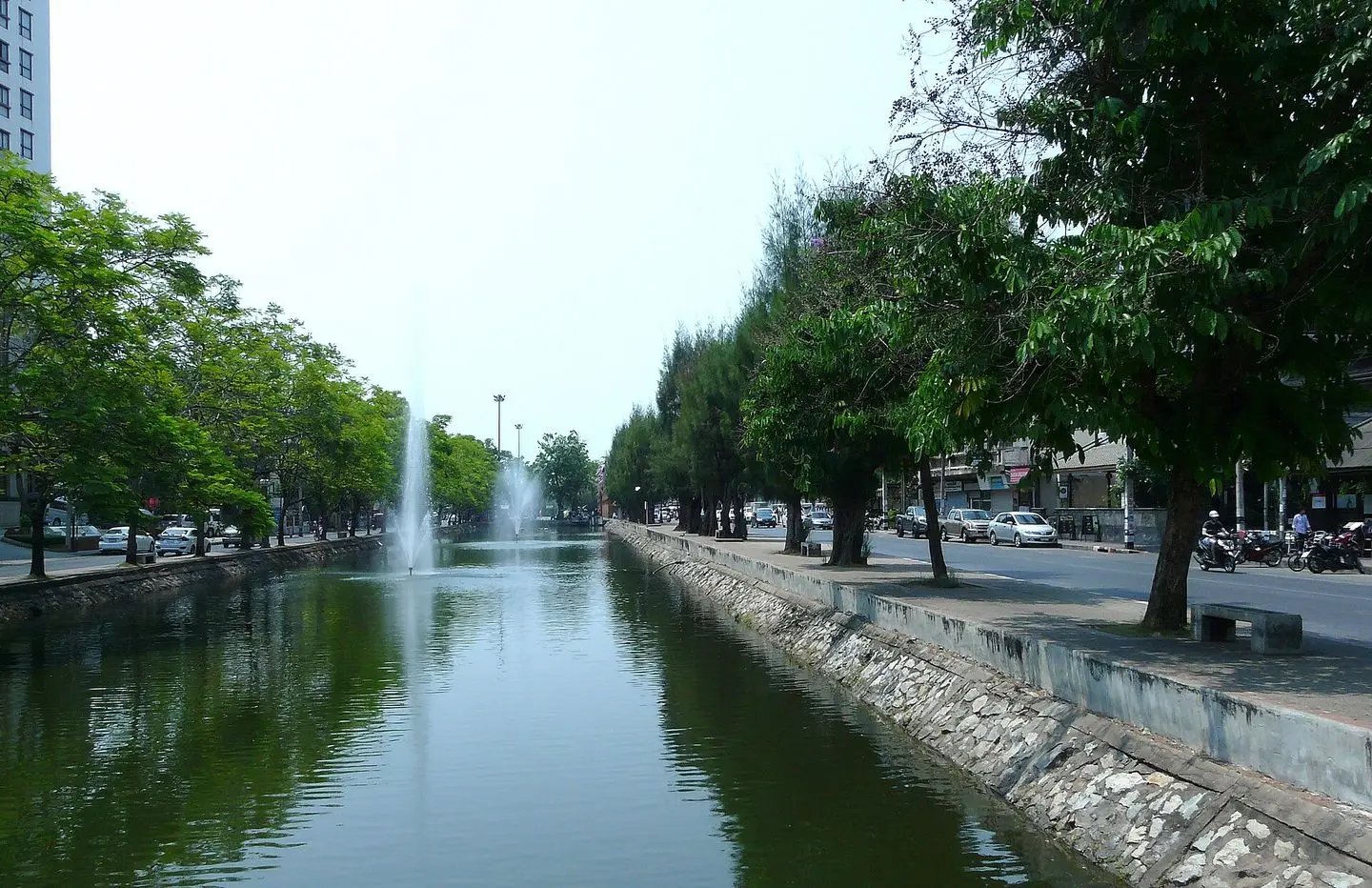
Traffic is calmer than Bangkok or Phuket, but the rush hours, roughly 07:30–09:00 and 16:30–18:30, clog the moat, Huay Kaew Road and the superhighway. A car sits in them; a scooter filters to the front at every light, which is legal and expected here. Old Town to Nimman is ten minutes on a scooter and fifteen to twenty-five by car, plus the parking hunt.
The alternative to both is not bad: red songthaews (shared pickup taxis) cover the centre for about ฿30 a head (2026) and a Grab or Bolt car is roughly ฿60–150 across town. If you only want to move between the Old Town, the Night Bazaar and Nimman, no vehicle at all is a legitimate answer. The moment you want the mountain, the waterfalls or a café at the end of a dirt lane, you need wheels of your own.
Parking
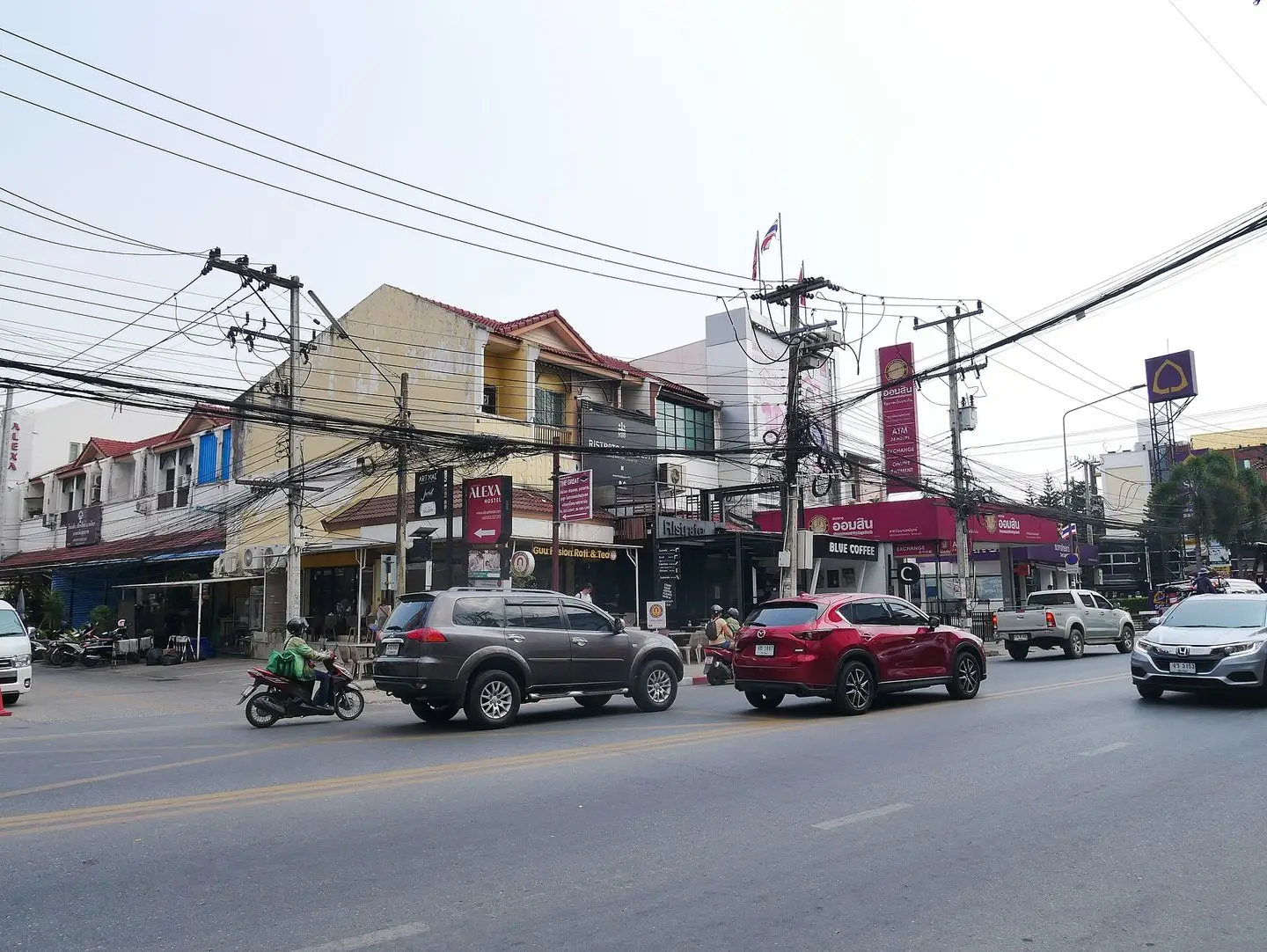
This is where the comparison is lopsided. Locals park scooters at the kerb outside wherever they are going, and it costs nothing: ride up, kick the stand down, walk in.
In a car you plan around it. Hotels inside the Old Town often have two or three spaces or none, so ask before you book. The kerbside bays along the moat fill by mid-morning. On Nimmanhaemin the sois are too narrow to park on both sides, sensors have alerted the traffic police to cars blocking junctions since 2020, and a wheel clamp is a real possibility. Car drivers end up in the mall car parks (Maya, One Nimman, Central Festival) and at the big temples outside the walls.
Learn the kerb colours before you leave a car anywhere: red and white means no stopping at all, yellow and white means drop-off only, black and white means you may park. Fines start at ฿500 and a tow is possible. On Sunday from mid-afternoon Ratchadamnoen Road is the walking street, on Saturday evening Wualai Road is; park at the edge and walk in.
Day trips
The classic day rides are the scooter's home ground.
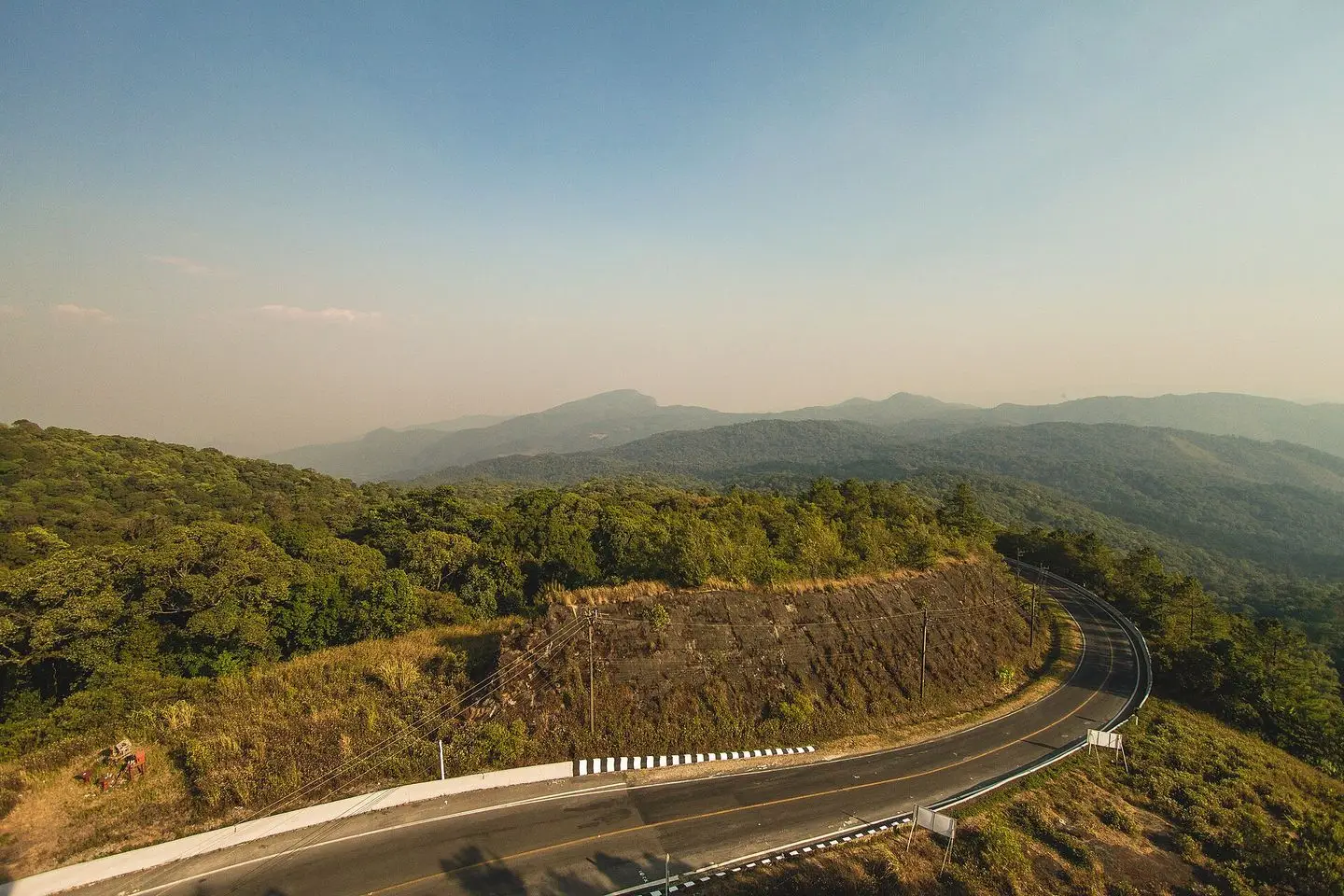
- Doi Suthep is 17 km from Tha Phae Gate, about 35 minutes up a well-surfaced road of bends. On a scooter you stop at the viewpoints; in a car you queue behind the songthaews and hunt for a space at the top (our Doi Suthep guide).
- Mae Kampong, the mountain village 50 km east, is an easy ride through orchards with a steep final 3 km (the route).
- The Samoeng Loop, about 100 km through the hills north-west of the city, exists for the riding; doing it in a car is like walking a ski slope (map and stops).
- Doi Inthanon, Thailand's highest mountain about 100 km south-west, is the one day trip where a car argues back: a long day, a cold summit, a family in the back seat. On a scooter it is still one of the best rides in the north (our guide).
Long trips
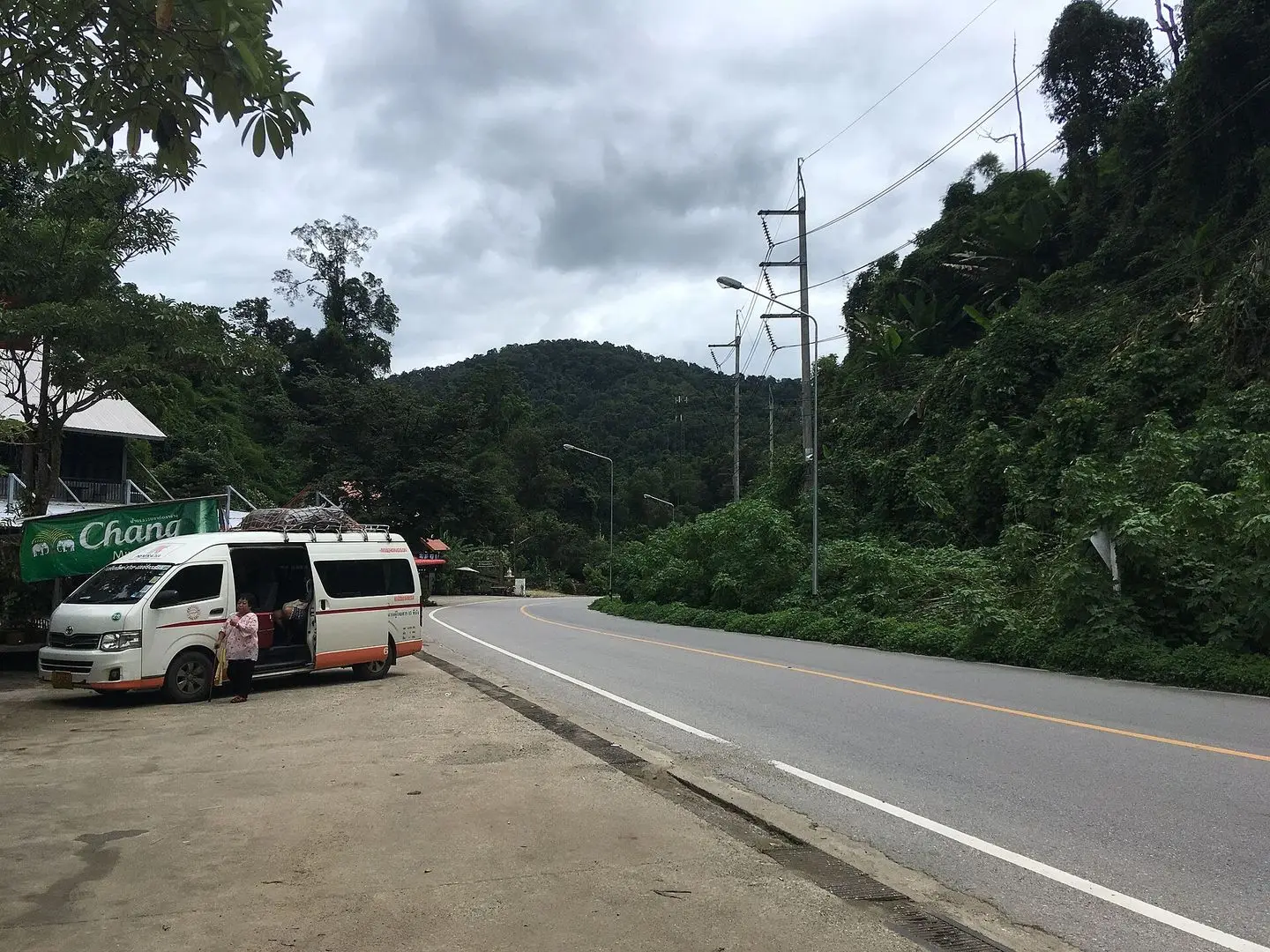
Pai is 130 km north-west on Route 1095, three hours in a car and nearer four on a scooter with stops, through the 762 bends the T-shirts boast about. It is a riding road: in a car you are a passenger of the bends, on a scooter you are in them. Plenty of our customers do it on a Click 125 or a Giorno and come back delighted; two-up with luggage, the ADV 350, ADV 160 and PCX 160 are all ideal. Minivans run all day if you would rather rent in Pai (the full Pai guide).
The Mae Hong Son Loop, about 600 km over three to five days, is the same argument stretched across a week. A car does it comfortably; a scooter does it properly (our Loop map and plan).
Chiang Rai is the exception and the clearest case for a car. It is 185 km on Route 118, a transport artery with long climbs over Doi Saket and Mae Kachan, overtaking lanes, trucks and minibuses: three hours in a car, four on a scooter, and not much joy in either. Once there, the White Temple, the Blue Temple, the Black House and the tea plantations are spread over 40 km of flat farmland. A car, or the bus plus a scooter rented in Chiang Rai, suits it far better than riding up from Chiang Mai.
There is no mileage limit on our scooters: Pai, the Loop, Doi Inthanon and Chiang Rai are all normal trips, and the only rule is that the bike stays in Thailand.
Rain, heat and smoke
Rain. The rainy season runs May to October, heaviest in August and September. Most days it means one hard shower in the late afternoon, over in 30 to 60 minutes. On a scooter you pull under a petrol-station roof, drink a coffee and ride on; every rental of ours comes with two helmets and a free under-seat bag with a first-aid kit and two rain ponchos. What a scooter cannot do is get you across town dry at 17:00 in a downpour, or make a wet mountain road feel safe. A September week with places to be at fixed times is a car week (how the rains actually feel).
Heat. March and April run 35 to 40 °C. A car's air conditioning wins, a moving scooter beats a parked car, and midday in April is for cafés either way.
Smoke. From late February to mid-April the burning season fills the valley with haze. A car's filter helps a little; on a scooter you wear an N95 mask. With asthma, a car is kinder.
Luggage and kids
A scooter carries two adults, two small backpacks and a bag on the hook, and that is the honest limit. Two carry-ons for a weekend in Pai: fine. Two suitcases: car, or send the bags ahead by minivan.
Children settle it faster. Thai law has required a child seat for under-sixes and seat belts in every seat since September 2022 (fine up to ฿2,000); ask the hire company for a seat when you book, because they do not come by default. On a scooter a child is legal with a helmet, and Thai families ride four to a bike every day. We would not put a small child on a scooter in Chiang Mai traffic, and we say that as the people who would rent you the scooter. A family with small kids is a car family here.
Licences and checkpoints
This is the part most people get wrong, and the part that costs money.
For a scooter you need a motorcycle licence from home plus an International Driving Permit that shows the motorcycle category. A car licence is not enough: the IDP only mirrors the categories on your home licence, so no motorcycle on the licence means none on the permit. Thailand recognises permits under both the 1949 and the 1968 conventions (it ratified the 1968 one on 1 May 2020), so the permit your own motoring organisation issues is the right one; the British government's advice tells UK riders to carry the 1968 version with their licence.
Police checkpoints on the moat, on Huay Kaew Road and at the foot of Doi Suthep are routine. Without a licence the fine is ฿500 and the receipt works as a three-day pass. The real cost is elsewhere: without the right licence your travel insurer will very likely refuse your hospital bill, and a scooter crash here can run into hundreds of thousands of baht. No helmet is a separate fine of up to ฿2,000 per head. Our licence guide goes through the categories country by country.
For a car you need your home licence plus an IDP, which the hire companies do check, a credit card in the driver's name, and usually to be 21 or over with a licence at least a year old. Basic insurance is included, most policies carry an excess of several thousand baht, and the deposit is a hold on your card. Thailand drives on the left and the drink-drive limit is 0.05.
Safety, honestly
A car is safer than a scooter, and the numbers are not close. In 2025, 16,078 people died on Thailand's roads and 12,808 of them, about 80 per cent, were on a motorcycle; the 2024 figures were 17,447 and 14,144. Of the motorcyclists admitted to hospital between 2020 and 2024, 84 per cent wore no helmet. These are Department of Disease Control figures for the whole country, where most of the dead are young Thai men on 110 cc bikes at night. A sober, helmeted visitor riding at 40 km/h in daylight carries a fraction of that risk, but not zero, and a car's steel shell is real.
What that means in practice:
- If you have never ridden a scooter, Chiang Mai traffic is not where to learn. Take a car, or take a lesson first on a quiet road. We hand keys to first-timers every week and tell some of them, kindly, not to take them.
- Helmet done up, both of you, every ride. The fine is the small part.
- Never after drinking. Not after two beers. A Grab home costs less than the beers did.
- Stay off mountain roads after dark and in heavy rain.
- Ride slowly and assume the pickup will pull out. It will.
Our road-safety guide covers the traffic habits that surprise newcomers, and Is Chiang Mai safe? puts the road risk next to everything else.
What it costs
We will not quote our own rates here; the booking page does that and they change with the season. In general terms, a scooter is a fraction of a car's daily rate, fuel costs about a third, and parking is free.
Fuel. Gasohol 95 cost about ฿40 a litre in November 2026. A 125–160 cc automatic uses two to two and a half litres per 100 km, so roughly ฿80–100 per 100 km; a small hire car uses six to eight litres, roughly ฿250–320.
Car hire. Typical aggregator prices for Chiang Mai in November 2026: a small automatic such as a Toyota Yaris from about ฿650–1,000 a day, an average booking around ฿1,000–1,500, an SUV or seven-seater ฿1,800–2,500. December is the dearest month and May the cheapest; add the deposit hold and the excess.
Everything else. No toll roads, nothing to pay for parking a scooter, and for the evenings you would rather not drive at all, the songthaew and Grab fares above.
So which one?
Take a car if
- you are travelling with small children
- you have never ridden a scooter and your first attempt would be on Thai roads
- you are here in the heart of the rainy season with places to be on time
- Chiang Rai is on the list, or any long flat drive
- you are carrying suitcases rather than backpacks
- you do not hold a motorcycle licence and would rather not gamble on insurance
Take a scooter if
- there are one or two of you and you are based in the city
- Doi Suthep, Mae Kampong, the Samoeng Loop or Pai are the point of the trip
- you hold a motorcycle licence and an IDP with the category on it
- you want to park outside the café instead of three streets away
Do both if your trip has two halves: a car for the Chiang Rai or family leg and a scooter for the city days, or a scooter all week and a car for the one wet day with a long drive in it. We deliver to your hotel in minutes, free, so there is no need to decide for the whole trip on day one; online booking covers the city, and for an address outside Mueang Chiang Mai message us first.
If a scooter is the answer, the two-minute scooter finder will tell you which one, and our guide to the best things to do in Chiang Mai will give you somewhere to ride it.
Quick questions
Is it better to rent a scooter or a car in Chiang Mai?
For one or two people staying in the city and doing day trips, a scooter: it parks anywhere, costs a fraction of a car and is the better way to ride the mountain roads. A car makes more sense for a family with small children, for someone who has never ridden, for a week of heavy rain, or for the long haul to Chiang Rai.
Can I ride a scooter in Thailand with a car licence?
No. Legally you need a motorcycle licence from home plus an International Driving Permit that carries the motorcycle category; a car-only licence does not cover a scooter, and your travel insurance will usually refuse a claim without the right licence. At a checkpoint the fine for riding without one is ฿500, and the receipt works as a three-day pass.
Do I need an International Driving Permit to drive in Thailand?
Yes, for a car and for a scooter. Thailand recognises permits issued under both the 1949 and the 1968 road-traffic conventions, so the one your home motoring organisation issues is the right one. Carry it together with your national licence; the permit on its own is not valid.
How much does it cost to rent a car in Chiang Mai?
On the booking aggregators in November 2026 a small automatic such as a Toyota Yaris starts around ฿650–1,000 a day, the average booking is roughly ฿1,000–1,500 and an SUV or seven-seater is about ฿1,800–2,500. December is the dearest month and May the cheapest. Add fuel at about ฿40 a litre and a credit-card deposit.
Is parking a problem in Chiang Mai?
On a scooter, no: locals park at the kerb outside wherever they are going, free. In a car it is the daily chore, above all in the Old Town and on Nimmanhaemin, where the side streets are narrow and red-and-white kerbs mean no stopping at all. Malls, temples and most hotels outside the Old Town have car parks.
Can I take a rental scooter to Pai or Chiang Rai?
Yes. There is no mileage limit on our scooters and Pai, the Mae Hong Son Loop, Doi Inthanon and Chiang Rai are all normal trips; the only rule is that the bike stays inside Thailand. Pai is 130 km of bends and a joy on a scooter; Chiang Rai is 185 km of transport road, which most people find more pleasant in a car or a bus.