San Kamphaeng Hot Springs and Bo Sang by scooter: the easy east loop
The flattest day ride from Chiang Mai: the old craft road through Bo Sang, a cave with 180 steps, eggs boiled in a hot spring and a foot soak, then home on the fast road. About 80 km, with map and 2026 prices.
Tap a numbered stop for details. The route line is indicative — grab an offline map for turn-by-turn.
San Kamphaeng Hot Springs is a park of lawns and flower beds 36 km east of Chiang Mai, where two jets of near-boiling water shoot into the air and families sit in a row with their feet in a warm stream, waiting for their eggs to cook. It is not a wild place and not a spa. It is a very Thai day out, and we like it for exactly that.
The ride there is the easiest one on our map: flat nearly all the way, paved throughout, never far from fuel or a coffee. This is the loop we would do, out along the old craft road through Bo Sang and home on the fast one, with a cave on the way for anyone who wants to earn the soak.
The route at a glance
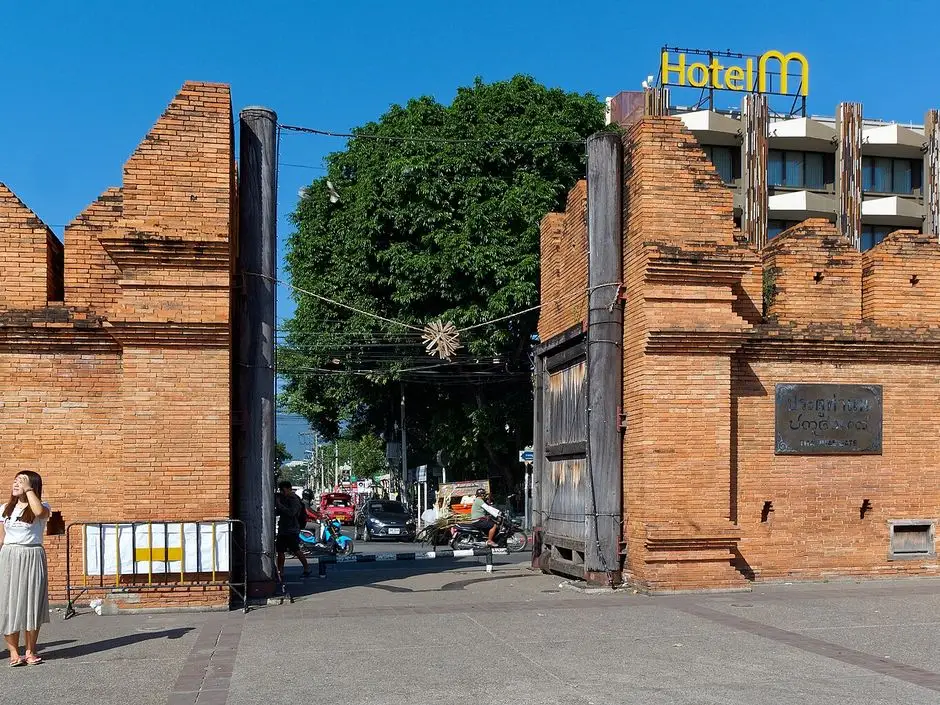
- 1Tha Phae Gate (Old Town) Start. Straight on down Tha Phae Road, over the river and along Charoen Muang Road, which becomes Route 1006, the old San Kamphaeng road.
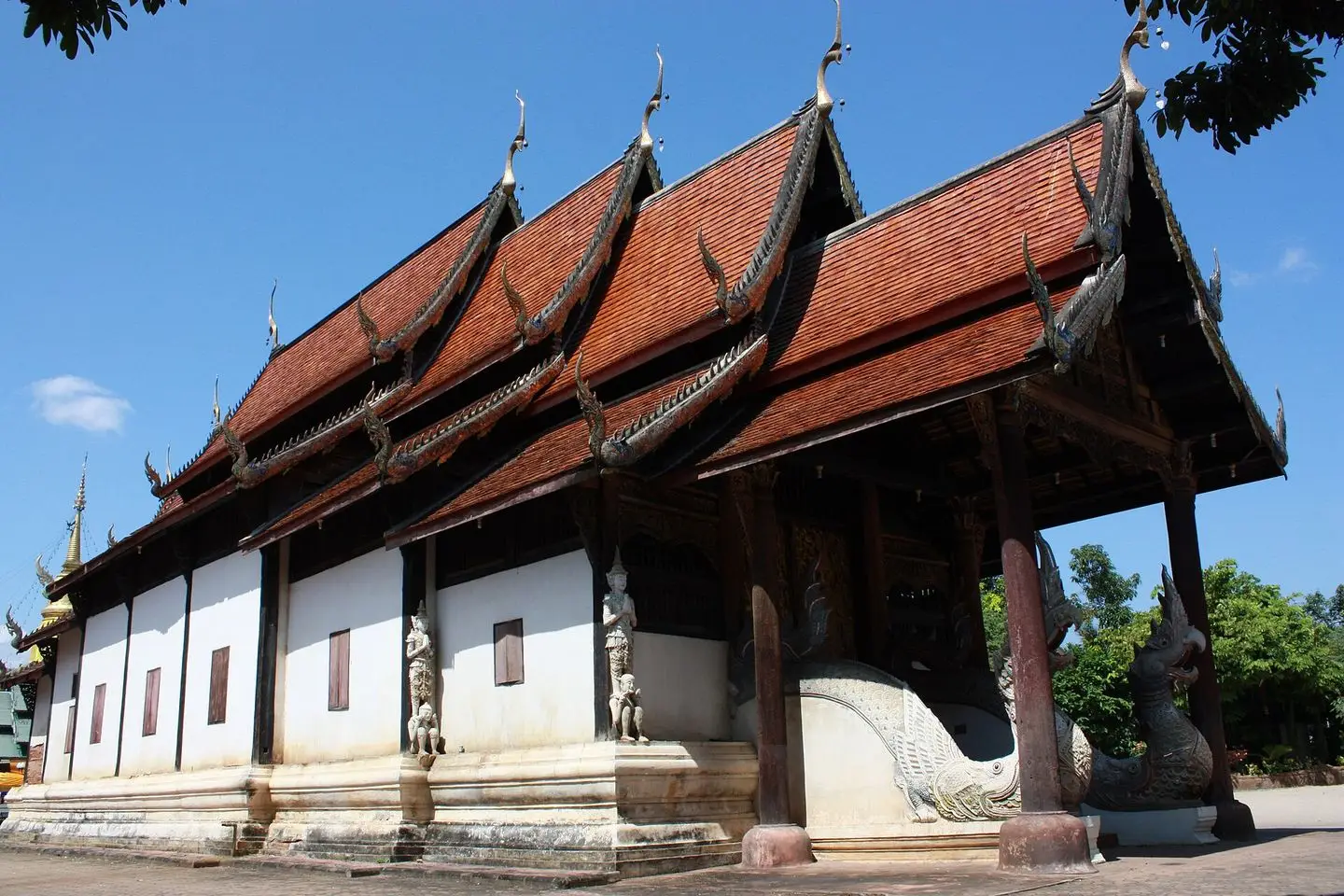
- 2Wat Buak Khrok Luang 6 km out, just off the main road. A small Lanna prayer hall with 19th-century murals on every wall. Ten quiet minutes.
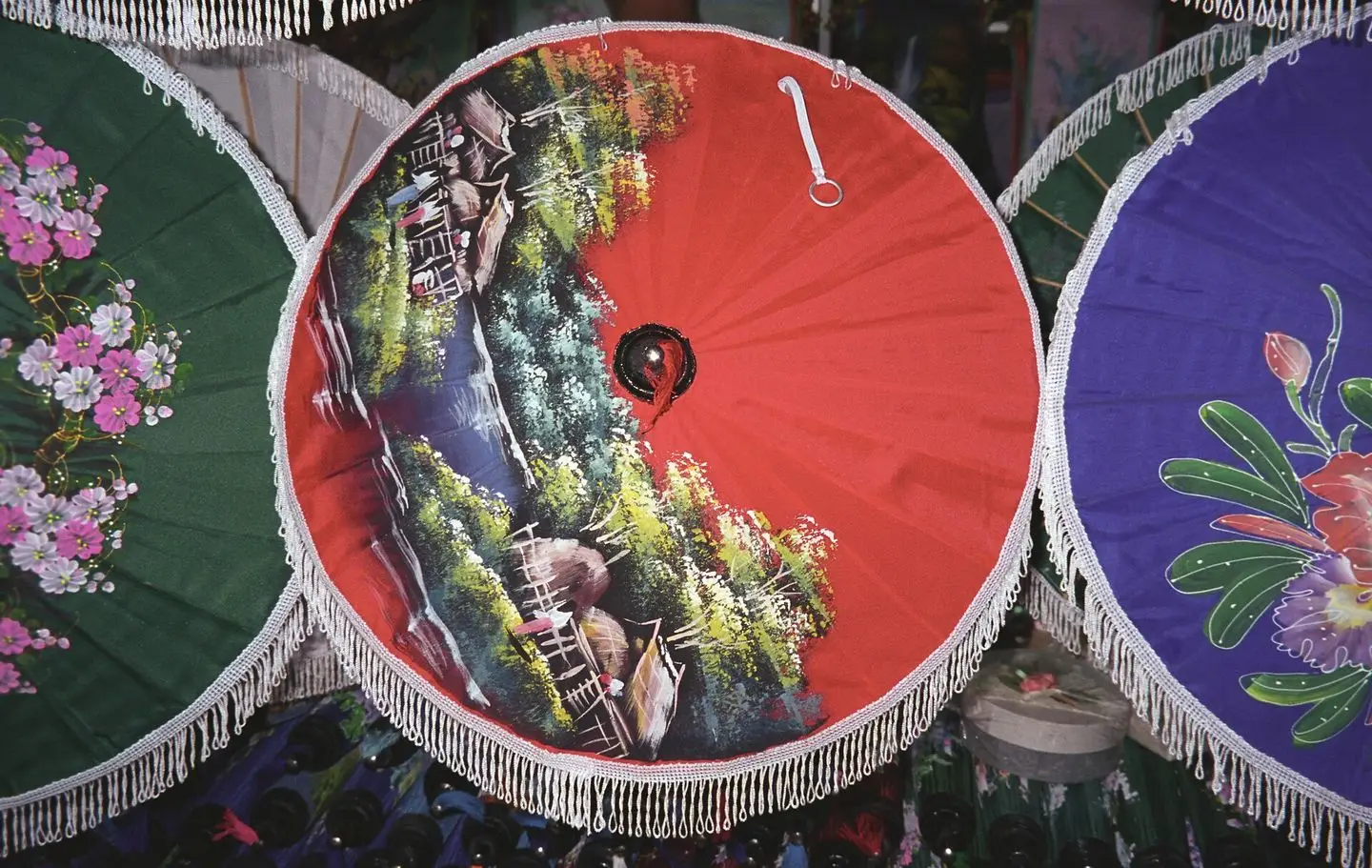
- 3Bo Sang (umbrella village) 12.5 km out. Turn left at the junction for the Umbrella Making Centre, where you watch paper umbrellas made by hand from the bamboo frame to the last brush stroke. Free.
- 4MAIIAM Contemporary Art Museum 1.5 km past the Bo Sang junction, on the right behind a wall of mirror tiles. Thai contemporary art in a converted warehouse; ฿200 (2026).
- 5San Kamphaeng town The district town, 17.5 km out. Fuel, cash machines and lunch before the road empties.
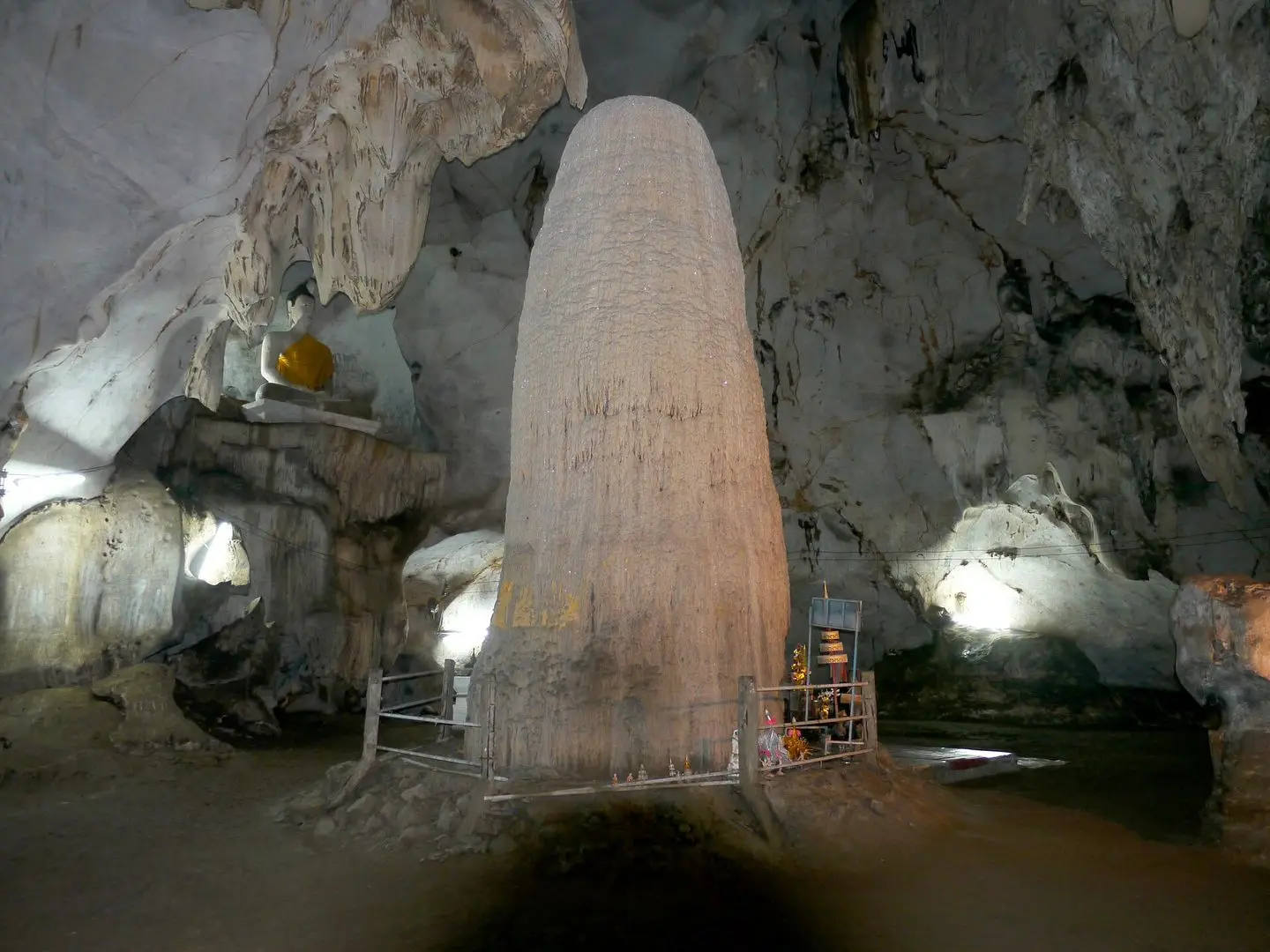
- 6Muang On Cave 1 km off Route 1317, signed. About 180 steps up to the mouth, then steep steps down into a lit chamber with a huge stalagmite. Skip it if stairs are not your thing.
- 7San Kamphaeng Hot Springs The destination. Two geysers, a warm stream for your feet, eggs boiled in the spring and mineral baths. ฿100 for foreign adults, ฿50 for children (2026).
- 8Route 1317 (the new San Kamphaeng road) The way home: stay on Route 1317 past the junction where you joined it and it runs straight back to the ring road at Promenada, 20 km on.
The day, leg by leg
Old Town → Wat Buak Khrok Luang → Bo Sang
East through Tha Phae Gate, over the river and out along Charoen Muang Road. Traffic lights and shops all the way. The temple is a short turn off the main road at 6 km; Bo Sang's junction is at 12.5 km, with the Umbrella Making Centre up the side road on the left.
Bo Sang → MAIIAM → San Kamphaeng town
Back on Route 1006. The museum is 1.5 km on, on the right; the craft showrooms line the road between here and town. Fill the tank and eat in San Kamphaeng if you have not already.
San Kamphaeng → Muang On Cave
Nine kilometres of quiet two-lane road east to the junction with Route 1317, then left and north towards the limestone hills. The cave is signed on the left after 7.5 km; the last kilometre climbs to the temple car park.
Muang On Cave → Hot Springs
Back to Route 1317, left for a kilometre, then left again at the hot springs sign. Three kilometres of village road bring you to the gate. Allow an hour and a half for the geysers, the eggs and a soak; longer if you book a bath.
Hot Springs → Route 1317 → Old Town
Back down to Route 1317 and simply stay on it. It passes the junction where you joined and carries on west for 20 km to the ring road at Promenada. From there it is 8 km of city streets to the moat. Leave the springs by 16:30 and you are home in daylight.
Why ride it
Most day rides from Chiang Mai go up a mountain. This one does not. The valley east of the city is rice fields, villages and low limestone hills, and the road across it is so gentle that it is the ride we suggest to anyone who collected their scooter yesterday and wants a first proper outing before trying Doi Suthep or the Samoeng Loop.
It is also a day with a point to it. The old San Kamphaeng road is where Chiang Mai's crafts have been made and sold for generations, so the way out passes painted umbrellas, a temple hall covered in murals and the best contemporary art museum in the north. Then the buildings thin out, a cave appears in a cliff, and at the end of the road there is hot water coming out of the ground and a basket of eggs with your name on it.
What it is not: dramatic. There are no hairpins and no viewpoints. If you want a road that makes your palms sweat, look at Mae Kampong, which starts along this same road and then climbs into the hills.
The road
The loop is about 80 km and every metre is paved.
Out on the old road (Route 1006). From Tha Phae Gate ride straight east: Tha Phae Road, the Nawarat Bridge, then Charoen Muang Road past the railway station. Further out it is signed as Route 1006, the old road to San Kamphaeng. It is two lanes through an almost continuous line of shops, workshops and school gates, with frequent traffic lights. It is slow rather than hard: watch for cars pulling out of side lanes and for songthaews stopping without warning. Past Bo Sang the old rain trees close over the road for a stretch and the ride gets prettier.
Across to Mae On. After San Kamphaeng town the 1006 turns into a quiet country road and runs 9 km east to meet Route 1317. Turn left. For the next 8 km you ride north with limestone cliffs growing on your left, past the turn for the cave, to the signed turn-off for the hot springs. The last 3 km are a village road.
Home on the new road (Route 1317). Coming back, do not turn off at the junction where you joined. Route 1317, the new San Kamphaeng road, runs straight back to the city: 20 km to the middle ring road at Promenada, wider and faster than the old road and with very little to stop for. Pickups and trucks move quickly on it, so keep left and let them pass.
Fuel and police. Stations are everywhere as far as San Kamphaeng town and there are more on Route 1317. Fill up in town and you will not think about it again. Checkpoints appear on the roads out of the city from time to time: helmets on both heads (the fine is up to ฿2,000 per person), and riding without a motorcycle licence costs ฿500, with a receipt that covers you for three days. The licence rules are explained here.
The stops
1. Tha Phae Gate
The Old Town's east gate points you the right way. Leave by 09:00 and you can do every stop below without hurrying; leave at 13:00 and you still have time for the springs alone.
2. Wat Buak Khrok Luang
Six kilometres out, a short signed turn off the main road leads to a village temple that most people ride straight past. The prayer hall is small, low and old, in the Lanna style with a three-tiered roof and naga stairs, and inside it every wall is painted. The murals date from the 19th century and tell the Buddha's last lives, the Jataka tales, but the painters filled the edges with what they saw around them: houses on stilts, soldiers, women at a market, a good deal of gossip. They are some of the best-preserved temple paintings in Chiang Mai and you will probably have them to yourself.
The hall is sometimes locked. If it is, ask in the temple grounds. Shoulders and knees covered.
3. Bo Sang
At 12.5 km you reach the Bo Sang junction. The village has made paper umbrellas for well over a century, and the craft is easy to see. Turn left at the junction and the Umbrella Making Centre is a few hundred metres up the side road.
It is a shop with a working yard, and the yard is the reason to stop. Each step has its own station: splitting bamboo for the ribs, threading the frame, stretching mulberry-bark paper over it, sealing, drying in the sun, and finally the painters, who put a bird or a branch of blossom on an umbrella in a few minutes without sketching anything first. It is free, nobody pushes you to buy, and the painters will decorate a phone case or a bag while you wait for a small fee. Twenty minutes is enough.
On the third weekend of January the village holds the Bo Sang Umbrella Festival: three days of parades, a street closed to traffic and women in traditional dress cycling past under parasols. It is charming and extremely crowded. In 2026 it ran from 16 to 18 January.
4. MAIIAM Contemporary Art Museum
A kilometre and a half past the Bo Sang junction, a long wall covered in thousands of small mirror tiles appears on the right. Behind it is MAIIAM, a private museum in a converted warehouse, built around one family's collection of Thai contemporary art from the last thirty years. If you think Thai art means temple murals and elephant paintings, an hour here will fix that. The exhibitions change, the building is cool and quiet, and there is a café.
Entry is ฿200 for adults (2026, from the museum's own site), ฿100 for students and free for children under 12. It is not open every day of the week, so check Google Maps before you plan the ride around it.
Between here and San Kamphaeng town the road is lined with large craft showrooms: silk, celadon, silverware, lacquer. They were built for tour coaches, and the tuk-tuk drivers who bring people here earn a commission. On your own scooter nobody earns anything, which makes them more pleasant: walk in, watch the weaving or the kiln for ten minutes, and leave if nothing appeals. The quality is real and so are the prices.
5. San Kamphaeng town
The district town is the last place with everything: fuel, cash machines, a market, noodle shops. Eat here if it is near midday. Beyond it the road turns rural quickly and the next reliable food is at the springs themselves.
6. Muang On Cave (optional)
On Route 1317, about 7.5 km after you join it, a sign points left to Tham Muang On. A short side road climbs to a temple car park under a limestone cliff, and from there a naga staircase of about 180 steps goes up to a mouth in the rock no wider than a doorway.
Inside, more steps go down, steeply, into a tall chamber lit with electric lamps. In the middle stands one enormous stalagmite, treated as sacred, with Buddha images in the niches around it and a reclining Buddha further in. It takes twenty minutes to see and it is cool in there in any season. Entry is reported at about ฿30; bring small notes.
Two honest warnings. The stairs inside are steep and can be damp, so wear shoes rather than sandals that slip. And if 180 steps up and the same again back sounds like a chore, skip it without guilt: the springs do not require it. The cliffs on this side of the hill, incidentally, are Crazy Horse Buttress, the best-known rock-climbing crag in northern Thailand.
7. San Kamphaeng Hot Springs
The park covers about 12 hectares of lawns, flower beds and old trees, with hills behind. The first thing you see is the geysers: two jets of water and steam that go more than ten metres into the air. They are not quite natural. In the 1970s the state electricity company drilled here to see whether the heat underground, around 105 °C, could drive a power station. It could, but not cheaply enough, and the project was dropped in 1983. The wells stayed, and a year later the place opened as a park, run to this day by the local cooperative village.
What you do here, in order:
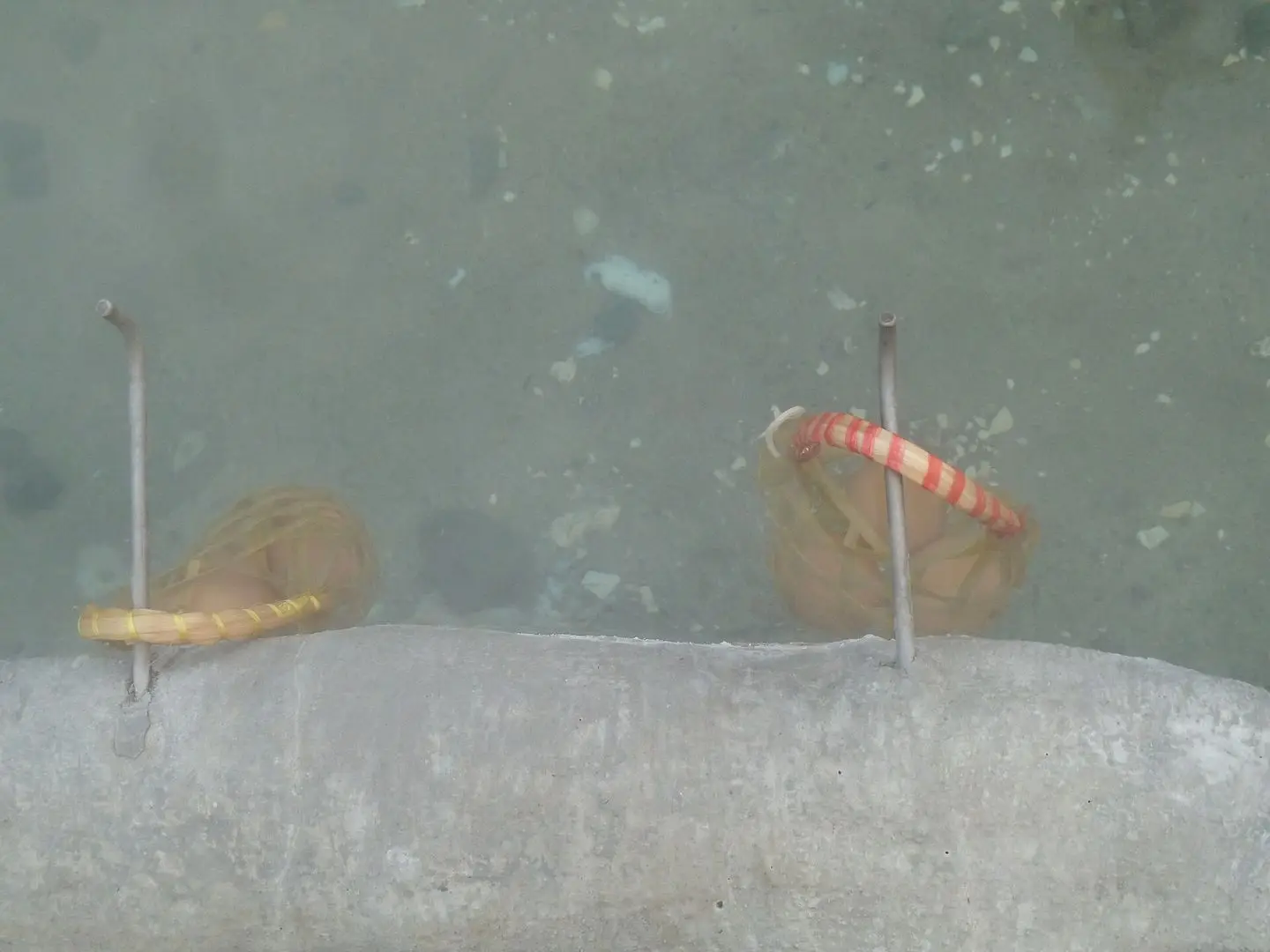
- Boil eggs. Kiosks sell chicken and quail eggs in little bamboo baskets. Hang yours in the stone-lined boiling pool, read the board for the minutes (soft, medium or hard), and collect it with a sachet of soy sauce. It is a small ritual and nobody is too old for it.
- Soak your feet. A channel of warm mineral water runs through the park, hottest near the source and cooler downstream. Sit on the edge with everyone else. This is included in the ticket.
- Have a proper soak. There is a mineral swimming pool (฿100 for foreign adults, ฿50 for children), private bath rooms in separate men's and women's blocks (฿65 per person) and larger pools that a group can rent by the hour. Towels and swimwear can be hired for a few baht. The bath rooms are plain tiled cubicles with a tub you fill yourself, not a spa, and after a morning on a scooter that is all you need.
- Lie down. Thai and foot massage is ฿250 an hour for foreign visitors (2026).
Entry is ฿100 for foreign adults and ฿50 for children (2026, from the park's own price list). The water smells faintly of sulphur, which you stop noticing after five minutes. Weekends and Thai holidays are busy with families and picnic mats; on a weekday morning it is half empty. Check Google Maps for today's hours.
A private resort with its own hot spring pools, Roong Aroon, is next door if you want something more like a hotel.
8. Home on Route 1317
Back down the village road, right on to Route 1317, and stay on it. In about 50 minutes you are at the middle ring road by the Promenada mall, and the moat is 8 km further. If you have had enough of the springs by early afternoon and still have energy, Mae Kampong is about 22 km beyond them in the other direction, but that is a different, steeper day and deserves its own.
Which bike
The ADV 350, ADV 160 and PCX 160 are all ideal for this loop: comfortable seats for 80 km, room under them for towels and swimwear, and plenty in hand for overtaking on Route 1317. A Giorno is completely fine too, and a Click does the job, two-up included: the route is flat, and the only climb is the short side road to the cave.
Every rental from us comes with two helmets and the free under-seat bag with a first-aid kit and two rain ponchos, and there is no mileage limit. If you are still choosing a model, the two-minute finder helps.
When to go
November to February is the best time: cool mornings make hot water far more appealing, and the fields are green or golden. Go on a weekday if you can.
March to May is the hot season, and sitting in hot water when the air is 38 °C is a specialised pleasure. Go early, soak before 10:00, and treat the rest as a ride. The smoke haze of March and April does not spoil this route the way it spoils mountain views, but it is no fun to ride in either.
In the rainy season, June to October, the valley is at its greenest and the park at its quietest. Showers are usually short; pack the ponchos and sit one out with a coffee (more on riding in the rains).
Costs (2026)
- San Kamphaeng Hot Springs entry: ฿100 per foreign adult, ฿50 per child.
- Mineral swimming pool: ฿100 per foreign adult, ฿50 per child. Private bath room: ฿65 per person.
- Massage at the springs: ฿250 per hour.
- MAIIAM: ฿200 per adult, ฿100 students, under 12 free.
- Muang On Cave: about ฿30.
- Bo Sang Umbrella Making Centre and Wat Buak Khrok Luang: free.
For more rides like this one, the pillar guide to the best things to do in Chiang Mai has the full list of day trips, with a map for each.
Quick questions
How far is San Kamphaeng Hot Springs from Chiang Mai?
About 36 km east of the city, in Mae On district. On a scooter it takes around 50 minutes on Route 1317, or about an hour on the old road through Bo Sang and San Kamphaeng town.
How much is the entrance fee at San Kamphaeng Hot Springs?
฿100 for foreign adults and ฿50 for foreign children; Thai adults pay ฿40 (2026, from the park's own price list). The mineral swimming pool is another ฿100 for foreign adults and a private mineral bath room is ฿65 per person.
Can you swim or bathe at San Kamphaeng Hot Springs?
Yes. The foot-soak stream is included in the entry ticket. For a full soak there is a mineral swimming pool, private bath rooms split into men's and women's sections, and group pools rented by the hour. Towels and swimwear can be hired at the desk.
Can you really boil eggs in the hot spring?
Yes, and almost everybody does. Kiosks in the park sell chicken and quail eggs in small bamboo baskets, you hang the basket in the boiling pool, and a board beside it tells you how many minutes to wait for soft, medium or hard.
Is the ride to San Kamphaeng Hot Springs suitable for beginners?
It is the easiest day ride out of Chiang Mai: flat, paved all the way, with fuel and shops for most of the distance. The traffic in the first 15 km needs attention, and you need a motorcycle licence and a helmet as on any Thai road.
When is the Bo Sang Umbrella Festival?
On the third weekend of January each year; in 2026 it ran from 16 to 18 January. The 2027 dates had not been announced when we wrote this, but the pattern points to 15–17 January. The main street closes to traffic for the parade, so park at the edge of the village and walk in.