Huay Kaew Waterfall, Chiang Mai: ten minutes from Nimman
The closest waterfall to the city is ten minutes from Nimman, behind the Kruba Srivichai monument. It is small, it now costs foreigners ฿100, and in the right months it is still worth an hour. When to go, what to skip.
What it is
Huay Kaew is the closest waterfall to Chiang Mai, and by some distance. It sits at the very foot of Doi Suthep, where Huay Kaew Road stops being a city street and becomes the mountain road, tucked behind the Kruba Srivichai monument and a few hundred metres past the zoo. From Nimman it is 4 km. You can leave a café on Soi 9 and have your feet on wet granite ten minutes later.
Be clear about what you are riding to. This is not a jungle waterfall with a turquoise pool. It is a mountain stream that drops about 10 m down a face of dark granite, then runs on over slabs and between boulders, with shallow pools, a small footbridge and big trees over all of it. People from Chiang Mai have been coming here for decades to sit on the rocks with som tam and sticky rice, and on a weekend that is still what you find: families, students from the university down the road, runners cooling off after the hill.
The name means crystal stream. The water starts high on Doi Suthep, comes down through Montha Than waterfall, slides under the Pha Ngoep cliff, rests in the pool called Wang Bua Ban and reaches the city side of the mountain here.
Is it worth it
Honestly: it depends on the month and on what else you are doing.
Until 2025 the answer was easy, because it was free. Since 1 October 2025 Huay Kaew is inside the fee zone of Doi Suthep–Pui National Park, and a foreign adult pays ฿100. For that money, in March, you get a damp rock. In September you get a loud, full waterfall in deep green forest, ten minutes from your hotel, and it is a fair price.
Our rule of thumb:
- July to November: go. This is when it looks like the photos.
- December to February: go if you are passing, on the way up to Doi Suthep or back from the Monk's Trail. The stream is thinner but the shade and the rocks are pleasant.
- March to May: skip it. Little water, hot rock, hazy air.
And if what you want is a real waterfall day, with climbing and swimming, this is not it. Ride out to the Sticky Waterfalls instead.
Getting there by scooter
From the Old Town, leave by the north-west corner of the moat and follow Huay Kaew Road all the way: past Maya and the Nimman junction, past the front gate of Chiang Mai University, past the zoo. It is about 7 km from Tha Phae Gate and takes 15 minutes outside rush hour. The road is wide and well surfaced, and busy with students around 08:00 and 16:30.
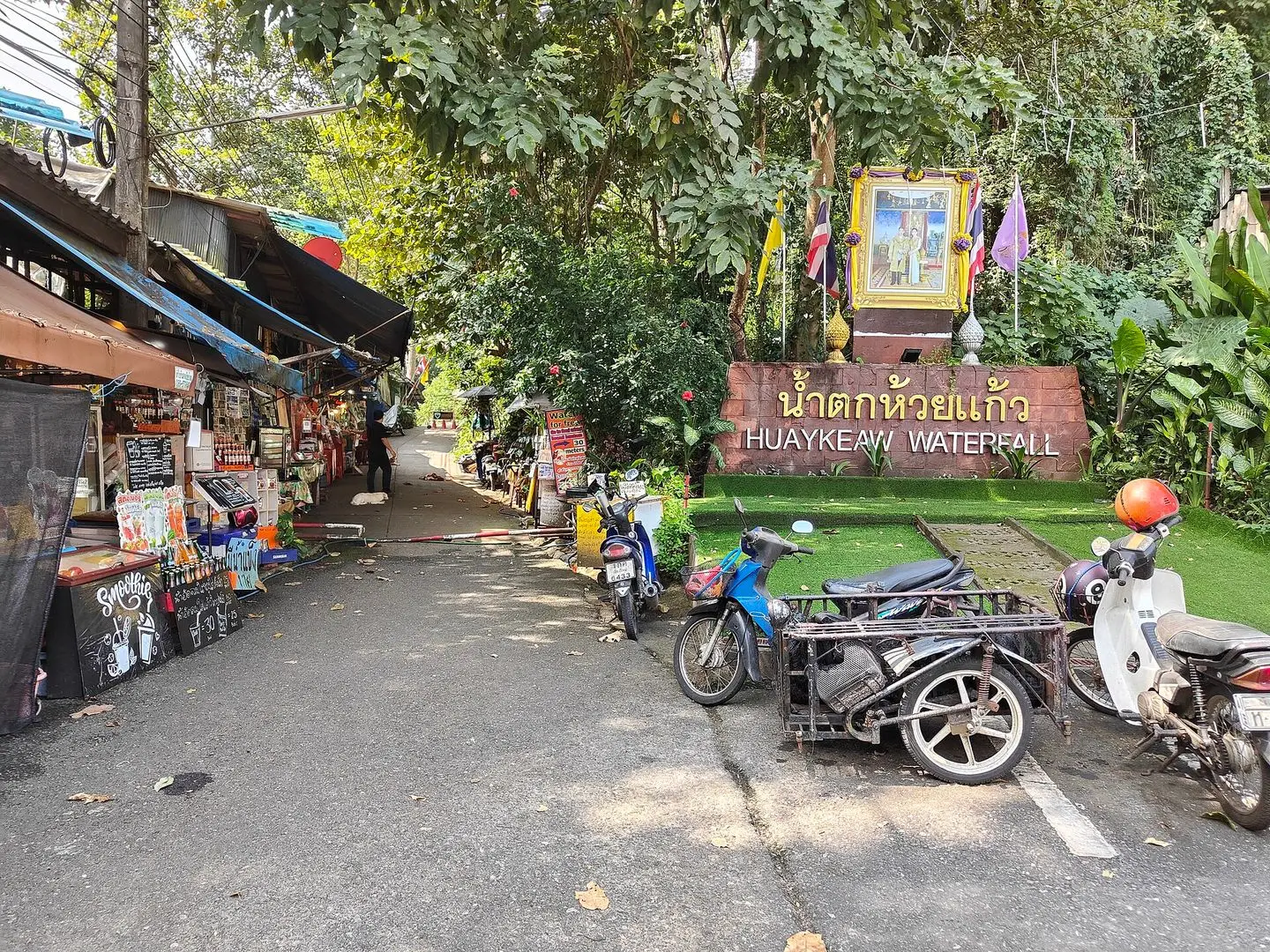
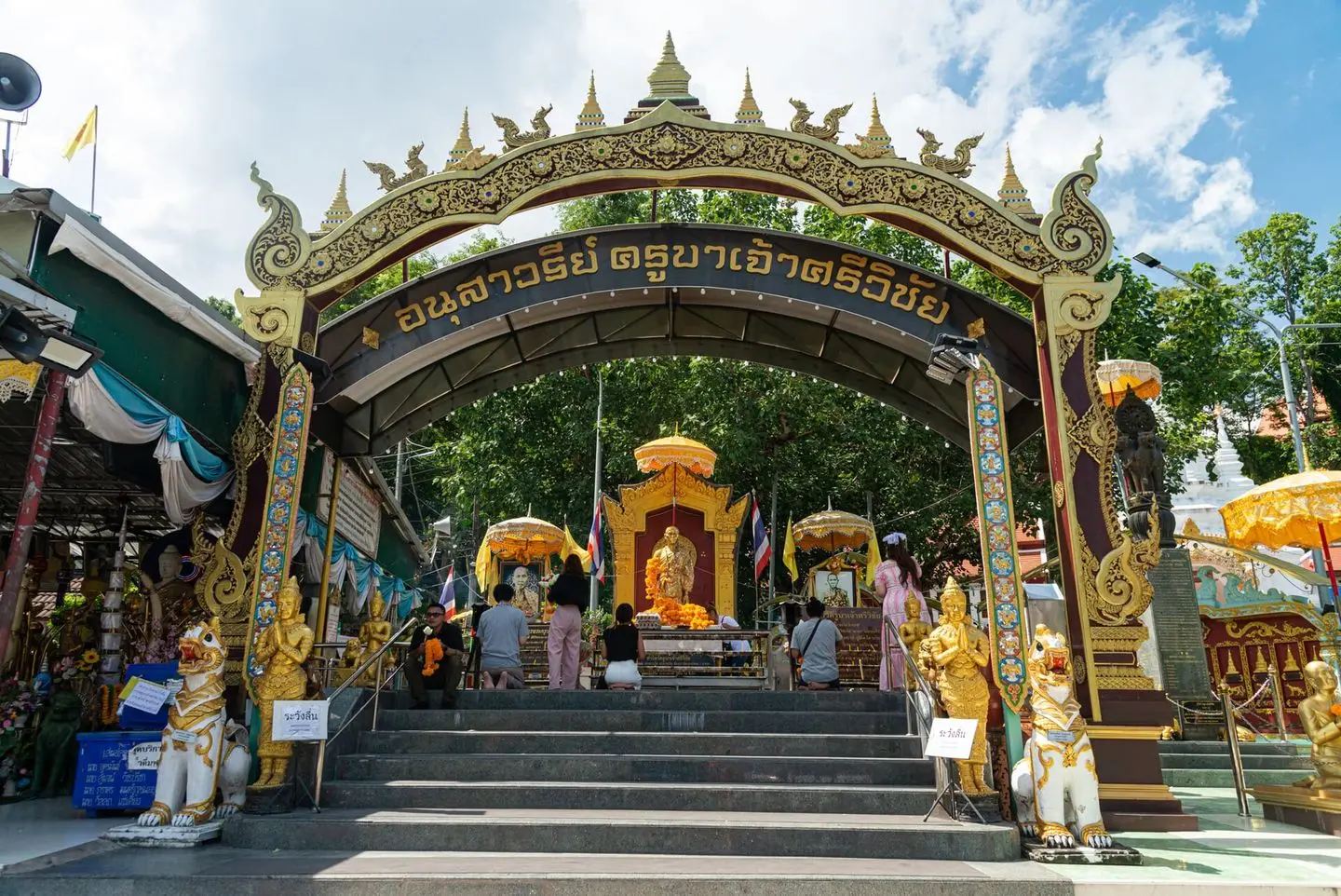
Where the road starts to climb you will see the Kruba Srivichai monument on your right, with its golden arch and a constant small crowd making offerings. The lane to the waterfall is the first on the left after the monument, marked with a sign. A short way in you reach the stalls and the waterfall sign.
Huay Kaew Road is a regular place for police checkpoints. Helmets on both heads (the fine is up to ฿2,000 per person), and carry your licence: riding without one is a ฿500 fine, and the receipt covers you for three days.
Parking. Do what the locals do and leave the scooter in the entrance lane by the sign, next to the other bikes. It is roadside parking and it is free. Lock the helmets under the seat.
Not riding? Any red songthaew heading for the zoo or Doi Suthep will drop you at the monument; it is a five-minute walk from there.
What it costs (2026)
- Foreign adults ฿100, foreign children ฿50.
- Thai adults ฿20, children ฿10.
- Cash. Keep the ticket.
The fee is the national park's, introduced on 1 October 2025 for Huay Kaew, Wang Bua Ban and Pha Ngoep, the Pha Lat Nature Trail (the Monk's Trail) and Doi Pui (the Citylife report has the announcement). A lot of websites have not caught up and still call the waterfall free. If you are also walking the Monk's Trail or riding up to Montha Than the same day, show your ticket and ask whether it covers you there too; we have not seen that confirmed either way.
Opening hours are published differently everywhere, so check Google Maps for today's hours, and do not plan an evening visit: park sites shut in the late afternoon.
What to do there
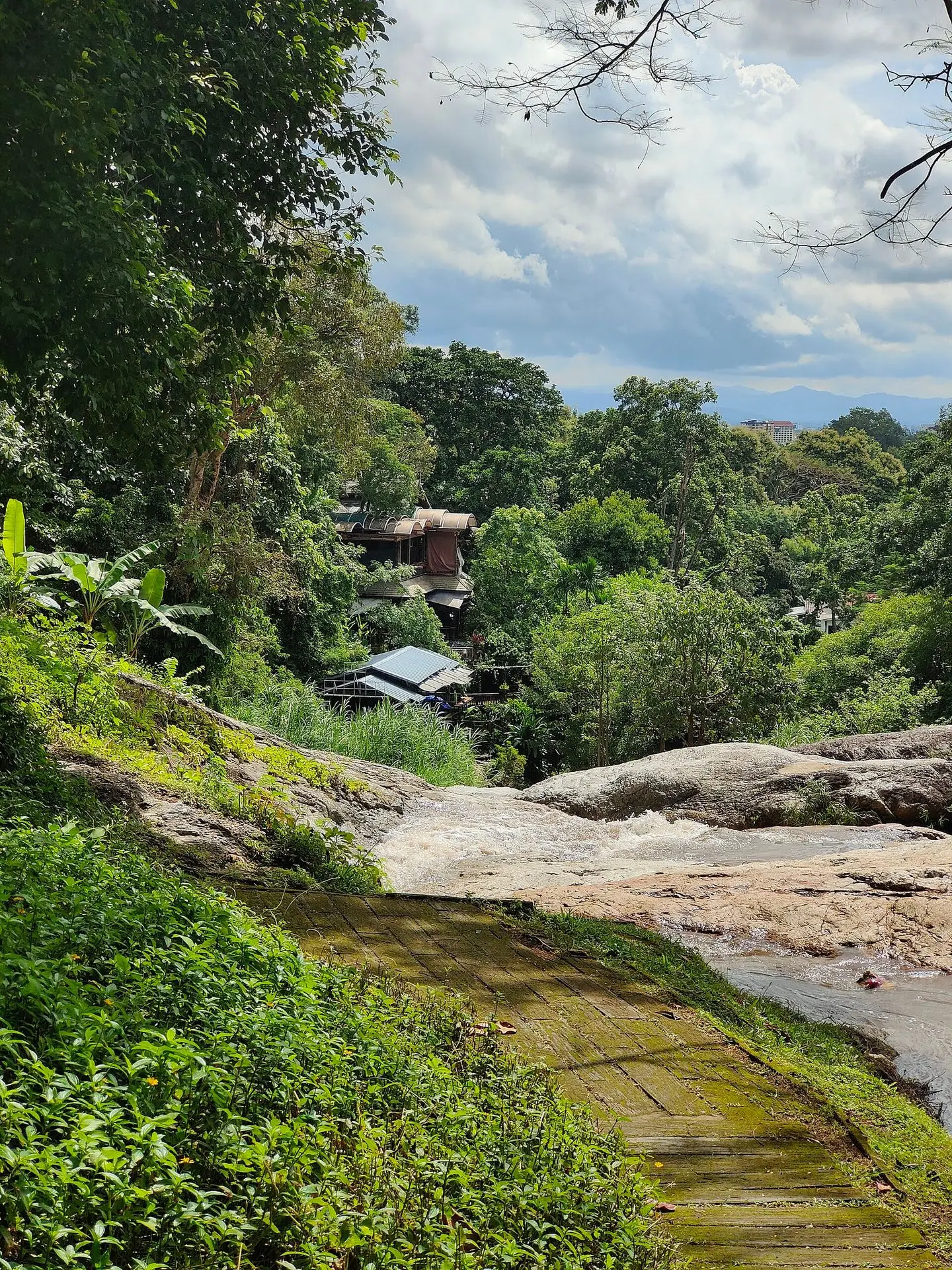
The lower falls. A short path from the entrance brings you to the stream and the main drop. Cross the little footbridge and follow the path up the far side for the better view: from the rock slabs above the falls you look back down the valley towards the city. Take your shoes off, sit on a warm rock with your feet in the water. That is the whole activity, and it is a good one.
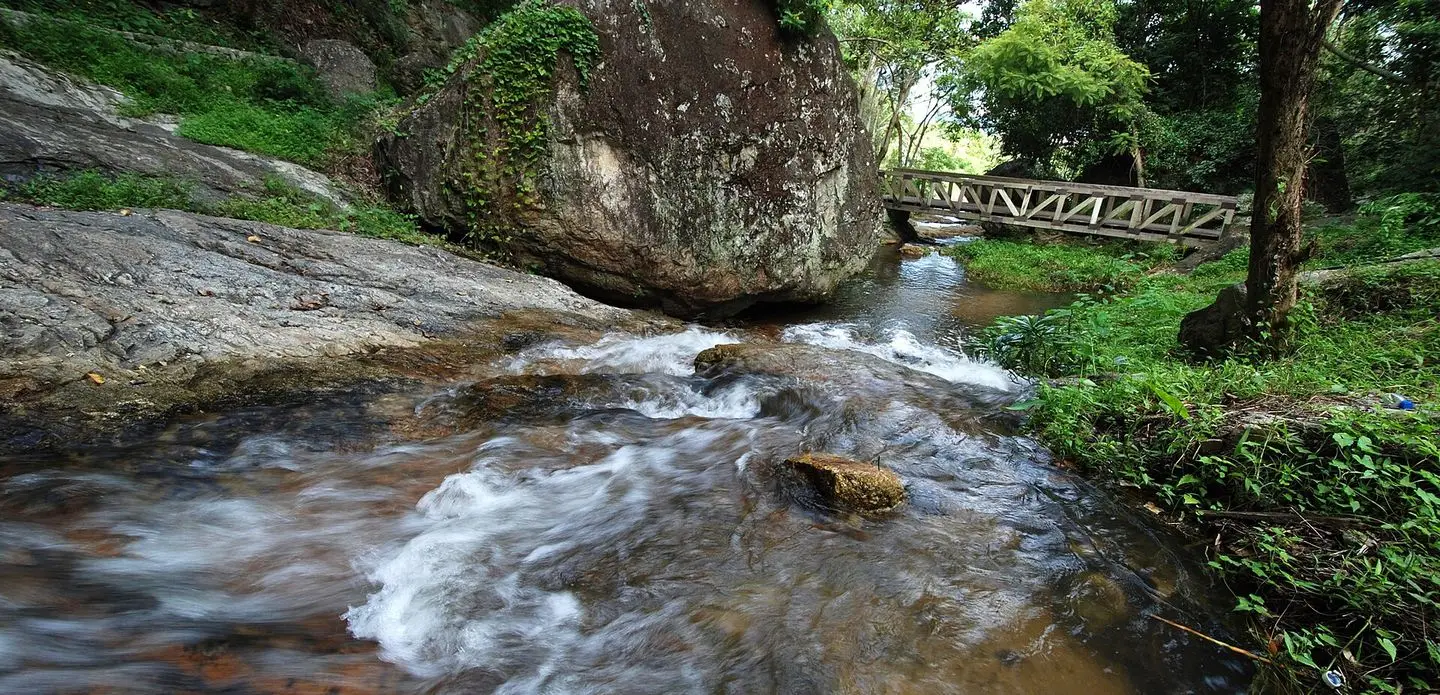
The walk to Wang Bua Ban. From the top of the falls a trail continues upstream: about 800 m and 75 m of climbing, 20 minutes at an easy pace, on stone, concrete and bare rock. It ends at Wang Bua Ban, a deep pool in the rock with a pavilion looking over it. Another 300 m on is Pha Ngoep, an overhanging cliff beside the stream. It is a proper little forest walk and far quieter than the falls. Wear shoes with grip, not flip-flops; the rock is slick wherever it is wet.
If you would rather not walk, Wang Bua Ban has its own lay-by and viewpoint on the Doi Suthep road, 1.6 km above the monument on the left.
Eating. The stalls at the entrance sell the standard Thai waterfall picnic: som tam, grilled pork and chicken, sticky rice, cold drinks. No alcohol; it is a national park and the rule is posted.
The water: where to paddle and where not to
The pools at the lower falls are shallow, and when the stream is low and clear children paddle in them all day. That is fine.
Wang Bua Ban is different. It is deep, and when the stream is in flood it turns into a whirlpool. A visitor drowned there in October 2017 after going in against the wardens' warnings. Look at it from the pavilion.
After heavy rain the whole stream changes character quickly: brown, fast and much higher. The park bans bathing at all its waterfalls when that happens, and it is right to. If the water is brown, stay on the path. In the wet months, our rainy season guide has more on reading the weather.
The story of Bua Ban
"Wang Bua Ban" means Bua Ban's pool, and many Thais know the name from an old ballad and the story told with it: a young Chiang Mai teacher, abandoned by an army officer from Bangkok, who ended her life here.
The real Bua Ban Chaiwongkaew was a schoolteacher, and she did die at this pool, in February 1946. The rest is less certain than the legend. Her family has said publicly that there was no officer and no love affair behind it, and a Chiang Mai University study in the 1980s concluded that her death was an accident. What is left is a quiet pool with a sad name. Locals treat it with respect, and so should you.
What else is nearby
- The Kruba Srivichai monument, at the lane's entrance. He was the monk who led the volunteers who built the road up Doi Suthep in 1935, and almost everyone riding up stops to pay respects first.
- [Doi Suthep](/blog/doi-suthep): the temple is 10 km up the same road, 25 minutes of curves. The waterfall makes a good cool-down on the way back.
- [The Monk's Trail](/blog/monks-trail-chiang-mai): the trailhead is about 15 minutes away by Canal Road. Hike at dawn, waterfall and som tam afterwards.
- Montha Than Waterfall: higher up the mountain road on a signed side road, bigger, with nine tiers. The better choice if you have half a day rather than half an hour.
- Chiang Mai Zoo is next door, if you have children with you.
Which bike
This is a ten-minute ride on a city road, so the bike will not decide your day: anything we rent does it comfortably. If you are carrying on up to Doi Suthep afterwards, an ADV 350, ADV 160 or PCX 160 are all ideal for the climb and the descent, a Giorno is completely fine too, and a Click will do the job, especially solo and travelling light. Every rental from us includes two helmets and the free under-seat bag with a first-aid kit and two rain ponchos, which in waterfall season you will probably use. The two-minute finder helps if you are undecided.
For everything else on the mountain and around it, see our guide to the best things to do in Chiang Mai.
Quick questions
Is Huay Kaew Waterfall free?
Not any more. Since 1 October 2025 it is in Doi Suthep–Pui National Park's fee zone: ฿100 for foreign adults and ฿50 for children, ฿20 and ฿10 for Thais. Many older guides still say it is free.
How do I get to Huay Kaew Waterfall from Chiang Mai?
Follow Huay Kaew Road west past Maya, the university and the zoo. At the foot of the mountain you pass the Kruba Srivichai monument; the lane to the waterfall is the first on the left after it. It is about 7 km from Tha Phae Gate and 4 km from Nimman, ten to fifteen minutes on a scooter.
Can you swim at Huay Kaew Waterfall?
You can paddle in the shallow pools at the lower falls when the stream is low and clear. Do not swim at Wang Bua Ban, the deep pool upstream, and stay out of the water altogether after heavy rain: the park closes its waterfalls to bathing when the streams are in flood.
When is the best time to visit Huay Kaew Waterfall?
July to November, when the rains keep the stream full. From December it thins out, and between March and May it can be little more than a trickle over bare rock. Go in the morning on a weekday for the quietest hour.
How long do you need at Huay Kaew Waterfall?
Half an hour covers the main falls and the rocks above them. Allow an hour and a half if you walk the 800 m trail up to Wang Bua Ban and on to the Pha Ngoep cliff.
What is Wang Bua Ban?
A deep rock pool on the same stream, about 800 m above Huay Kaew Waterfall. It is named after Bua Ban, a Chiang Mai schoolteacher who died there in 1946 and whose story became a well-known Thai song. There is a pavilion and a viewpoint beside it, also reachable from a lay-by on the Doi Suthep road.