Chiang Mai weather month by month: what it's like to ride
Twelve months, the official numbers behind them, and what each one means on a scooter: when the mountains are clear, when the sky opens at 16:00, and how to ride the hot and the hazy weeks well.
The short answer: ride Chiang Mai between November and February. The roads are dry, the sky is clear, the mornings are cool and the afternoons sit around 30 °C. November and December are the sweet spot, because the hills are still green from the rains and the smoke has not started. The month that needs planning is March, with the first half of April close behind: that is burning season, when haze sits in the valley and the mountain you came to see fades to grey. It is still a busy riding month here; you just ride it differently, early, and with a mask on the bad days. The rest of the year is better than its reputation. April is hot but short on rain, and the rainy season from mid-May to mid-October mostly means a clear morning, one loud storm in the late afternoon, and a wet hour under a roof.
The temperatures and rainfall below are the Thai Meteorological Department's official 30-year normals for the Chiang Mai station, 1991–2020, published in 2023; the smoke numbers name their own source. The city sits at 305 m in a valley between mountains, which is why a January day can start at 15 °C and reach 30 °C by mid-afternoon, and why anything you ride up to, from Doi Suthep to Doi Inthanon, will be colder and wetter than the city below. We hand over scooters all year; this is what each month actually feels like from the saddle.
The short version
- Best riding: November to February. Dry, clear, 15–20 °C at dawn, 29–33 °C in the afternoon.
- Hazy: late February to mid-April, smoke in the valley. March is the peak, and the month to plan around.
- Hottest: April, average high 36.7 °C. The 30-year record is 42.5 °C.
- Wettest: August, 223 mm over about 21 rainy days, with September just behind.
- The rain pattern: mornings mostly clear, one hard storm of one to three hours in the late afternoon or evening; grey all-day rain mostly from late August to early October.
January: cold dawns, clear roads
Average high 30.0 °C, low 15.7 °C, 11 mm of rain on about one day. This is the dry season at its driest and brightest, with 258 hours of sunshine in the month. Mornings are cold by Thai standards: 15 °C in the city at 07:00, several degrees less on the Samoeng loop, and 3–8 °C on the summit of Doi Inthanon, where frost sits on the grass on a cold morning. By 10:00 the jacket comes off.
Every big ride is open: Doi Inthanon, the Mae Hong Son Loop, Doi Ang Khang, Pai. The catch is the air. TMD's normals count 19 haze days in an average January, and in a bad year the first field burning shows up in the last week of the month. Views are still mostly fine, but the deep blue of December is turning milky. If a long mountain trip is the point of your visit, early January beats late.
February: warming up, hazing over
Average high 32.9 °C, low 16.8 °C, 10 mm of rain: the driest month of the year, with afternoon humidity down to about 31 per cent. Dawn is still cool, the afternoons are properly warm, and the Flower Festival fills the Old Town on the first weekend of the month.
This is also the month the sky changes colour. TMD counts 22 haze days in February. The median PM2.5 reading from city sensors in 2023–2026 was about 36 µg/m³, fine dust you can taste by mid-month, and the Thai daily limit of 37.5 µg/m³ is passed on many afternoons. Riding is still good and the mountains are still worth it before noon, but do the long rides in the first half of the month rather than the second. This is the last call for views before May.
March: the smoke
Average high 35.4 °C, low 20.1 °C, 20 mm of rain on two days. On paper a warm, dry month. In practice it is burning season, and the month that takes the most planning.
Farmers and foresters across northern Thailand, Myanmar and Laos burn fields and undergrowth before the rains, and Chiang Mai sits in a bowl that collects the smoke. TMD's normals show 27 haze days in March and 07:00 visibility of 6.2 km, against 11.8 km in June. Monthly PM2.5 averages have run around 80 µg/m³ in bad Marches (83.3 in 2021 from IQAir's sensor network, 79.2 in 2023 from Chiang Mai University's analysis of the official stations), five times the WHO daily guideline. In 2026 the province counted 5,090 fire hotspots by the end of March, 39 per cent more than in 2025, and on several days between 29 March and 1 April IQAir ranked Chiang Mai the most polluted major city in the world, with an air quality index of 235 to 263.
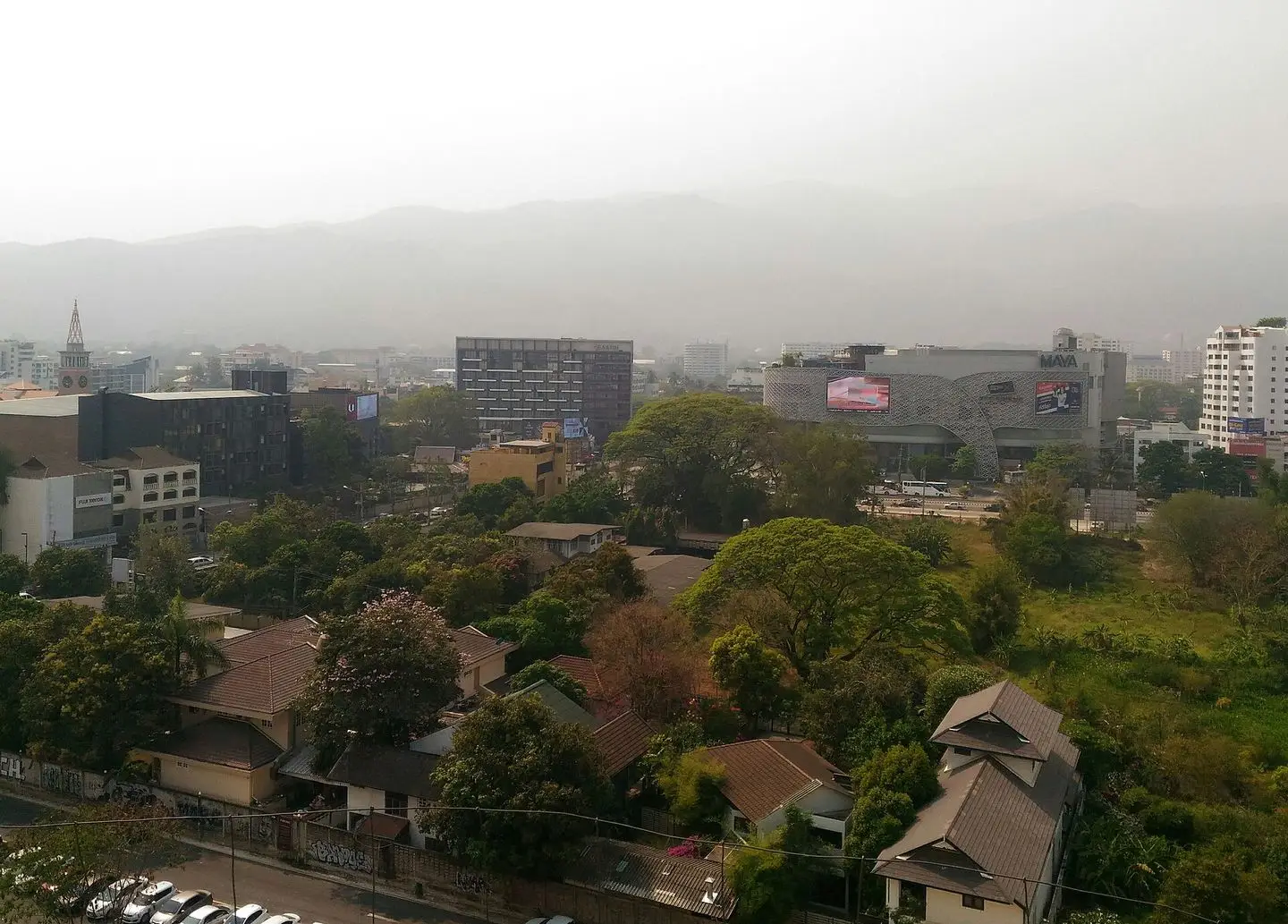
On a scooter that means an N95 mask under the visor on the bad days, early starts, and views that fade to grey: Doi Suthep, 15 minutes from the Old Town, is often only an outline. Plenty of people ride here all March; the trick is to use the mornings, when the air is at its best, keep the big mountain days for a clearer reading, and spend the hazy afternoons in the city, where the scooter is still the easiest way between cafés, markets and the pool. Check IQAir's live reading for Chiang Mai each morning, and read our honest page on Chiang Mai's risks if you have asthma, children or a lung condition.
April: the heat, then the water
Average high 36.7 °C, the hottest month, with nights around 23.4 °C and 54 mm of rain over about seven days. The 30-year record stands at 42.0 °C in April and 42.5 °C in May. The first thunderstorms arrive, almost five in an average April, and they finally knock the smoke down, usually in the second half of the month. In 2026 the city was still in IQAir's global top ten on 16 April.
Riding at 14:00 is like standing in front of a hairdryer. Ride at dawn and after 16:00, cover your arms, and drink more water than feels reasonable. Then there is Songkran 2027 (13–15 April), when the road around the Old Town moat becomes a three-day water fight. Riding through it means a soaking, slick roads, buckets of iced water in the face at 30 km/h and more drunk drivers than any other week of the year. Park the scooter for those afternoons and walk in. Our honest Songkran guide has the detail.

May: the switch flips
Average high 34.7 °C, low 24.2 °C, 168 mm of rain over about 15 days, and more thunderstorm days than any other month. Somewhere around the middle of May the first proper storm rolls over Doi Suthep, and within a week the air is rinsed clean: city sensor medians drop to about 14 µg/m³ and keep falling into single digits by June. The hills turn green almost overnight. Still hot, now humid, but the smoke is gone and the mornings are clear.
The pattern that holds until October starts here. Clear morning, clouds piling up after lunch, a hard storm somewhere between 15:00 and 19:00 that lasts one to three hours, then a washed, cool evening. The first 20 minutes of rain after a dry spell are the slickest, because the shower lifts months of oil and dust off the asphalt before washing it away. Every rental includes a free under-seat bag with a first-aid kit and two rain ponchos, which cover a short hop home; when the sky really opens, do what locals do and wait under a petrol-station roof. We wrote a whole page on riding through the rainy season.
June: the gentle wet month
Average high 33.2 °C, low 24.5 °C, 118 mm of rain over about 16 days. June often eases off after May's opening storms: shorter showers, plenty of dry days, humidity at 76 per cent. Hotels are quiet, the waterfalls are running again, and the Samoeng loop and Mae Kampong are at their greenest.
Riding is easy if you keep to the pattern: mountains before noon, city errands whenever, a café for the storm. Start using mosquito repellent at dawn and dusk; dengue circulates from now until the end of the rains. The one thing to watch is moss on shaded bends in the hills, which stays slick for hours after the road elsewhere has dried.
July: cloud on the passes
Average high 32.1 °C, low 24.3 °C, 149 mm over about 19 rainy days, and only 115 hours of sunshine, less than half of January's. July and August are the cloudiest stretch of the year: TMD's normals put cloud cover at eight-tenths of the sky. The city is warm and grey-white rather than wet all day, with the usual late-afternoon storm.
In the hills it is a different season. The passes on the Pai road and the summit of Doi Inthanon spend days inside cloud, and the famous viewpoints show you fog. Visors mist up, so crack them open; wet painted lines and manhole covers behave like ice; water-filled potholes are invisible, so give puddles respect. Fine for the city and the short loops; not the month for a summit photograph.
August: the wettest month
Average high 31.6 °C, low 24.0 °C, 223 mm of rain over about 21 rainy days, humidity at 82 per cent and the least sunshine of the year at 111 hours. The storms are heavier, and a grey day or two in a row stops being unusual. The upside is water: every waterfall around the city is at full volume and the mountains are as green as they get.
On the mountain roads the rain washes gravel and mud onto bends, moss grows on anything shaded, and in the worst weeks a landslide can close the Pai road or the Mae Hong Son Loop for a few hours. Ride mountains in the morning, check the sky before you commit, and be willing to turn around. In town the rule is simple: never ride through water you cannot see the bottom of. Ankle-deep at walking pace is the limit; deeper floods the engine intake and ends the rental.
September: soakers and the river
Average high 32.0 °C, low 23.7 °C, 207 mm of rain over about 18 days, and the second-highest count of thunderstorm days. When the remains of a typhoon drift across from Vietnam, the afternoon-storm pattern breaks and you get two or three days of steady grey rain. These are the afternoons we spend under a petrol-station roof.
September and early October are also flood-watch season for the Ping River. In early October 2024 it reached a record 5.30 m at the Nawarat Bridge and put the riverside markets and the Night Bazaar under a metre of water for days; the Old Town and Nimman, on higher ground to the west, stayed dry. Most years bring nothing worse than a flooded street that drains in an hour. For riding, the city is fine between the fronts; a long loop needs a flexible plan, so book nothing you cannot move by a day.
October: the turn
Average high 31.7 °C, low 22.6 °C, 124 mm of rain over about 12 days, tapering fast. The first week can still be wet; by the second half the storms are rare, the air is as clean as it gets all year, and the first cool mornings arrive at the end of the month. The hills are still green, the waterfalls still full and the hotels still cheap.
This is when the riding season reopens. The Mae Hong Son Loop, Doi Inthanon and Doi Ang Khang all come back onto the list, and the mountain viewpoints start giving views again. Keep the rain pattern in mind for the first two weeks, then forget it.
November: the best month
Average high 30.8 °C, low 19.9 °C, 41 mm of rain over about four days. Warm days, cool nights, clear skies, and everything still green from the rains: if you can pick one month, pick this one. The haze count is low, visibility is good, and from late October the valleys along the Pai road fill with a sea of mist at sunrise, best seen from the Doi Kio Lom viewpoint in Huai Nam Dang National Park, about 100 km out on the road to Pai.
It is also the month of Loy Krathong and Yi Peng, the lantern festival; in 2026 the two main nights fall on 24 and 25 November. Our guide to Loy Krathong and Yi Peng covers what is free, what is ticketed and where not to park. The Mae Hong Son Loop season begins in earnest now; pack a windproof layer, because the passes are 10 °C colder than the city at 07:00.

December: cold mornings, full hotels
Average high 29.2 °C, the coolest afternoons of the year, low 16.9 °C, 14 mm of rain. The 30-year record low in the city is 3.8 °C. This is peak season: hotels fill, Thai visitors drive up for the cold, and the roads to Doi Inthanon and Doi Ang Khang are busy at weekends and solid between Christmas and New Year. Thirteen haze days on average: the sky starts to lose its edge late in the month, but the views hold.
Doi Inthanon is the December ride. The summit at dawn is 3–8 °C, frost forms on the grass most mornings in a cold spell, and the ride down at 07:00 is genuinely cold, so bring gloves and something windproof. On the long descent keep your speed down, pump the brakes gently rather than holding them, and pull over to let them cool if the lever starts to feel soft. By the time you reach the Chom Thong plain it is 25 °C and you are peeling layers off again.
What to pack by season
Cool season, November to February. A windproof jacket or fleece for the first two hours of the day and for every descent; gloves if Doi Inthanon or Doi Ang Khang at dawn is on the list; sunglasses, because the low winter sun sits right in your eyes on east-west roads; sunscreen and lip balm, since afternoon humidity drops to about a third.
Hot and smoky season, March to April. N95 masks, sold in every pharmacy and convenience store, and worn under the visor on bad days; light long sleeves against the sun; two litres of water on any ride out of town; a dry bag or a waterproof phone pouch if you are here for Songkran, because everything on you will get wet.
Rainy season, May to October. The two ponchos in the under-seat bag cover a short hop; for a stay of weeks, a proper rain jacket, because a poncho becomes a sail at 60 km/h. A waterproof pouch for the phone, sandals or shoes with grip that dry overnight, mosquito repellent for dawn and dusk, and the habit of checking the sky at 14:00.
All year. The two helmets that come with every rental, done up. The forecast on the TMD English site is the one locals use; for the air, IQAir.
Quick questions
What is the best month to ride a scooter in Chiang Mai?
November to February. The roads are dry, the sky is clear and the mornings are cool, with average highs around 30 °C. November and December are the sweet spot: the hills are still green from the rains and the smoke has not started.
What is the worst month to visit Chiang Mai?
March, with the first half of April close behind. Field and forest burning fills the valley with smoke; in March 2026 Chiang Mai was ranked the most polluted major city in the world on several days. Mountain views go grey, so ride early, keep an N95 mask under the visor on bad days and save the long mountain rides for the clearer days. The city itself runs as normal.
How hot does Chiang Mai get in April?
April is the hottest month, with an average high of 36.7 °C and nights around 23 °C (Thai Meteorological Department normals, 1991–2020). The 30-year record is 42.5 °C. Ride at dawn and after 16:00, and drink more water than feels reasonable.
When is the rainy season in Chiang Mai, and does it rain all day?
Roughly mid-May to mid-October, peaking in August (223 mm, about 21 rainy days) and September. Most days follow one pattern: a clear morning, clouds building, one hard storm of one to three hours in the late afternoon or evening. All-day rain happens, mostly from late August to early October.
When is burning season in Chiang Mai?
The haze builds from late January or February, peaks in March and usually breaks with the first real storms in mid-to-late April. May is already clean. Between late February and Songkran check IQAir's live reading for Chiang Mai each morning and plan the mountain days around the better readings.
Is Chiang Mai cold in December?
By Thai standards, yes. City mornings are 15–17 °C and the record low is 3.8 °C. On the summit of Doi Inthanon the air at dawn is 3–8 °C and frost forms on the grass most cold mornings. Afternoons are a pleasant 29 °C. Bring a jacket for the first two hours of the day.