
Rainy season in Chiang Mai: what it's really like
Clear mornings, loud afternoons — what Chiang Mai's rainy season is actually like, month by month, and how to ride through it.

Monsoon skies over Doi Luang Chiang Dao. Photo: Janjira Jane / Wikimedia Commons (CC BY-SA 4.0)
"Rainy season" sounds like a dealbreaker, and for Chiang Mai it mostly isn't. The reality from roughly May to October is clear mornings, a loud 1–3 hour downpour somewhere in the afternoon or evening, and then it's done — the all-day soakers are rare and cluster into a few specific weeks. We ride through it every year; here's what to actually expect, month by month, plus how to handle a scooter when the sky opens.
The calendar, honestly
May is the switch-on: the heat finally breaks and afternoon storms start rolling in (~155 mm over ~15 days). June often eases off a little — short bursts, plenty of dry days. July builds again, and August and September are the peak: both around 200–260 mm, with August clocking the most rainy days (~21) and September bringing the occasional multi-day soaker when a typhoon remnant drifts in from Vietnam. October tapers off fast — by the second half it's often gorgeous — and November opens the cool, dry season.
For context: November–February is objectively the best weather of the year (cool, dry, clear), and March–April is hot season plus the burning-season haze — which, frankly, is a worse time to be here than any rainy month. If you're choosing between smoke in March and rain in August, take the rain.
What the rain actually looks like
The default pattern is simple: mornings are usually clear, clouds pile up through the day, and at some point there's an intense downpour that lasts one to three hours — often with a spectacular thunderstorm — and then it clears, leaving everything washed and cool. Plan outdoor stuff for the morning and keep the afternoon flexible, and rainy season barely touches you.
The honest exception: in late August to early October, when a tropical-storm remnant feeds the monsoon, you can get a grey, wet stretch lasting a day or three. Those are the weeks the "it only rains an hour a day" line oversells.
Is it a bad time to visit? Genuinely no
The green season has a real case: the mountains turn impossibly lush, the waterfalls are at their absolute best (August–October — and Bua Tong's sticky limestone keeps its grip even in the wet), the air is rinsed clean, the big sights are quiet, and hotels discount hard. The trade-offs are honest too: mountain viewpoints spend days in cloud — Doi Inthanon's summit pagodas in mist are atmospheric, but there's often no view — and plans need a plan B.
Riding a scooter in the rain
Short answer: yes, you can ride — locals do, all year, every year. You just adjust:
The first 20 minutes of rain are the slickest. After a dry spell, the first shower lifts the oil and dust film off the asphalt before washing it away — that's when roads are at their worst, not at their wettest.
Treat painted lines, manhole covers and wet leaves as ice. Zebra crossings, road markings, metal plates, moss on shaded corners — cross them upright, no braking, no lean.
Brake earlier, ride smoother. Double your following distance, ease the throttle, and slow down before corners rather than in them. Water-filled potholes are invisible — give puddles respect.
When it really opens up, just stop. This is the local move: pull under a petrol-station canopy or into a café, order something, and wait it out — most bursts are done within the hour. Riding blind through a monsoon downpour saves you twenty minutes and risks a lot more. And avoid riding at night in heavy rain entirely — visibility collapses.
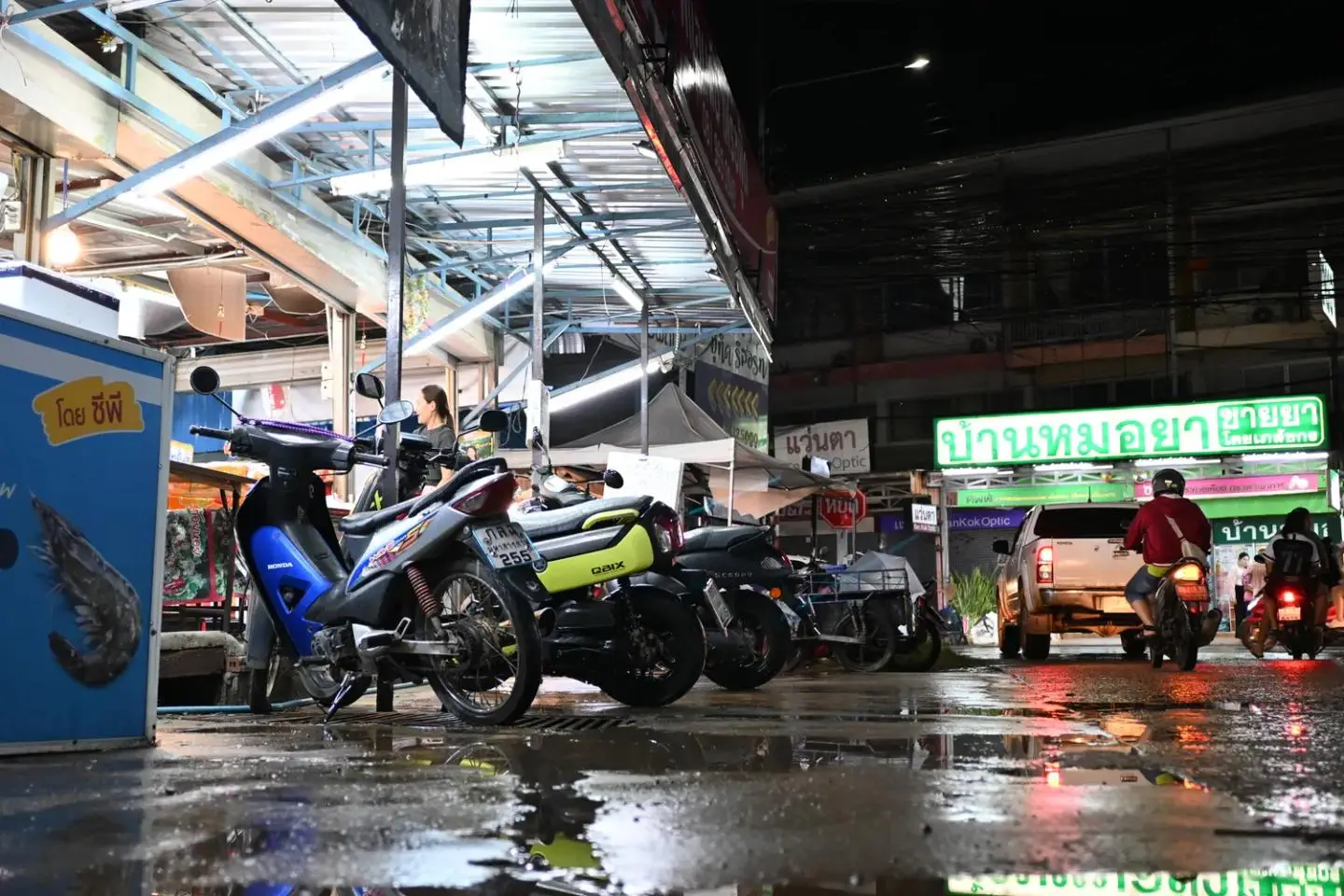
Gear: every CityGlide scooter comes with a free rain poncho under the seat — and if you ever need a spare, any 7-Eleven sells one for about ฿50. Fine for short hops. If you're here for the season, a proper rain jacket beats the poncho (which turns into a sail at speed). Crack the visor or helmet vents against fogging, and keep the phone in a waterproof pouch. More on riding here generally in our road safety guide.
Mountain roads: extra respect
The city is one thing; the 762 curves to Pai, the Samoeng loop and Doi Suthep are another. Rain washes gravel and mud onto bends, moss grows on shaded corners, clouds sit on the passes, and in the worst weeks (August–September) landslides genuinely close roads. The playbook: ride mountains in the morning, check the sky before committing, and be willing to cancel — some days the loop just isn't happening, and that's fine.
The flood question
September–October is flood-watch season. In the bad years the Ping River comes over its banks — October 2024 was the worst in ~50 years (the river hit 5.3 m), flooding the riverside markets, the Night Bazaar area and the east-bank streets around Faham and Wat Ket. The key fact for visitors: the Old Town and Nimman stayed dry — flooding here is a riverside-strip problem, not a whole-city one. Since then the city has raised the riverside flood barrier, and most years (like 2025) see nothing worse than brief street flooding after big bursts, which drains within the hour.
The rule on a scooter is simple: never ride through deep floodwater. If water gets sucked into the engine intake it hydrolocks — a dead engine and a repair bill no rental insurance covers. Ankle-deep, walking pace, along the crown of the road is the absolute limit; anything more, turn around and go the long way. Thinking of living here long-term? Our living in Chiang Mai guide has a flood-zone map worth a look before renting near the river.
The small stuff nobody mentions
Dengue is real in the wet months — mosquito repellent at dawn and dusk isn't optional, especially June–September. Laundry won't line-dry at 80% humidity — use the wash-and-dry shops with machine dryers, and give leather and closed wardrobes some airflow or they'll grow mold. On the upside, hotels discount heavily in low season, and tours run half-empty. It's a genuinely good-value time to be here.
Quick questions
When is rainy season in Chiang Mai?
Roughly May to October, peaking in August and September (each around 200–260 mm of rain). October tapers off quickly, and November–February is the dry, cool season with the best weather of the year.
Does it rain all day in rainy season?
Usually no — the default pattern is a clear morning and one intense 1–3 hour downpour in the afternoon or evening. Multi-day soakers happen, but they cluster into late August–early October when tropical-storm remnants pass through.
Can you ride a scooter in Chiang Mai during rainy season?
Yes — locals ride year-round. Brake earlier, treat painted lines and manhole covers as ice, keep a poncho under the seat (every CityGlide rental includes one free), and when a real downpour hits, pull over and wait it out — most pass within the hour. Avoid riding at night in heavy rain.
Does Chiang Mai flood in rainy season?
The risk window is September–October, and it's concentrated along the Ping River — the riverside markets and east-bank streets. The Old Town and Nimman stayed dry even in the record October 2024 flood. Never ride a scooter through deep floodwater; it can hydrolock the engine.
Is rainy season a good time to visit Chiang Mai?
Honestly, yes — the mountains are lush, waterfalls are at their best, the air is clean, crowds are gone and hotels are cheap. It beats the smoky burning season (February–April) comfortably. Just plan outdoor mornings and keep afternoons flexible.