Baan Kang Wat and Wat Umong: the slow west side of Chiang Mai
Ten minutes west of Nimman: a forest temple with brick tunnels and a village of wooden studios. One is best at seven in the morning, the other opens at ten and shuts on Mondays. The honest half day, with the ride.
What the west side is
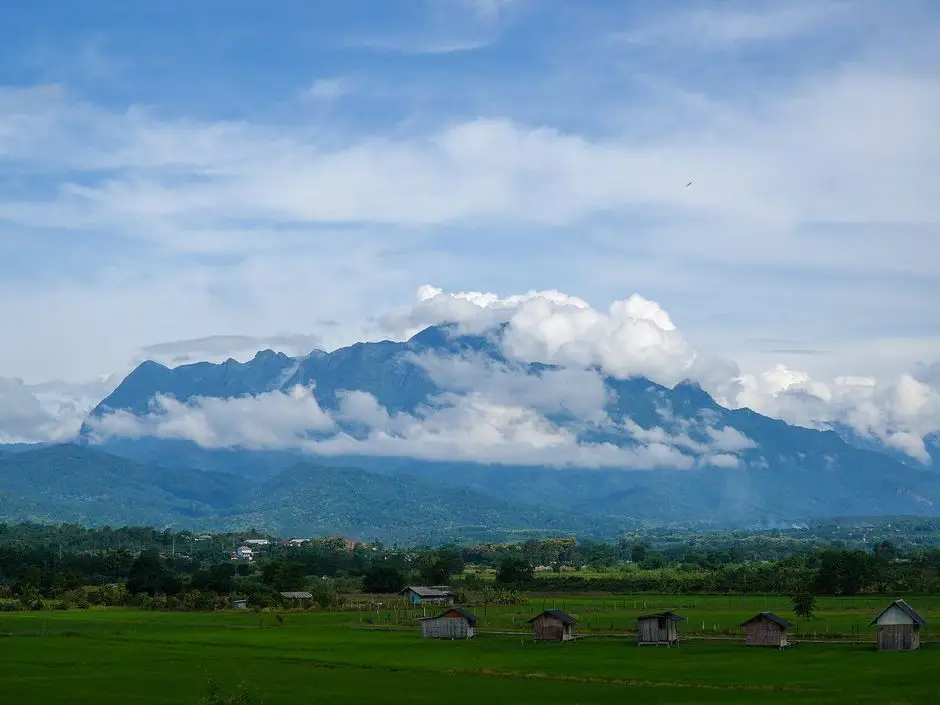
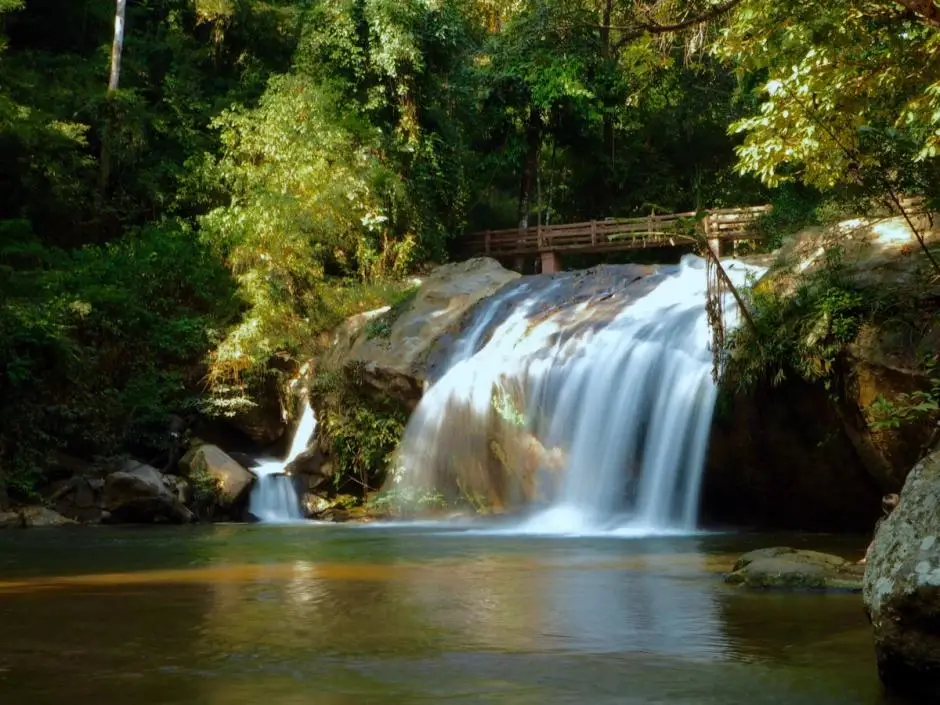
Suthep Road runs west out of the Old Town, past Wat Suan Dok, past the bottom of Nimman, and ends at the foot of Doi Suthep. Behind the long fence of Chiang Mai University, where the city gives up and the forest starts, a web of lanes holds two places: Wat Umong, a seven-hundred-year-old temple with brick tunnels under a moss-covered mound, and Baan Kang Wat, thirteen wooden houses where people make and sell things.
Neither is a big attraction, and that is the point. On a weekday morning you can have the tunnels nearly to yourself, drink a coffee by a pond, walk round the studios in forty minutes and be back on Nimman for lunch. We send people here once they have done the Old Town temples and want somewhere quieter.
Wat Umong, the tunnel temple
What it is
Wat Umong Suan Phutthatham sits in about six hectares of woodland at the foot of the mountain, a kilometre south of the university campus. King Mangrai founded it in 1297 for monks he had invited from Sri Lanka, and the bamboo grove it stood in gave it its first name. In the 1370s King Kue Na, who also built Wat Suan Dok, invited a revered monk called Thera Chan to live here, restored the chedi and had tunnels built into the mound beneath it on four sides. The temple was renamed after the monk; "umong" is simply the Thai word for tunnel.
The tunnels are why you come. Three brick corridors, vaulted and plastered, run into the mound and end in Buddha images set in niches, lit by a few lamps. The story everyone tells is that the king had them built so that his monk could meditate without wandering off into the forest, and had them painted with trees and birds to look like it. What is certain is that the ceilings carry murals roughly five hundred years old, among the oldest in Lanna: birds and peonies, lotus and clouds, in vermilion and green. They are fragments now; look hard.
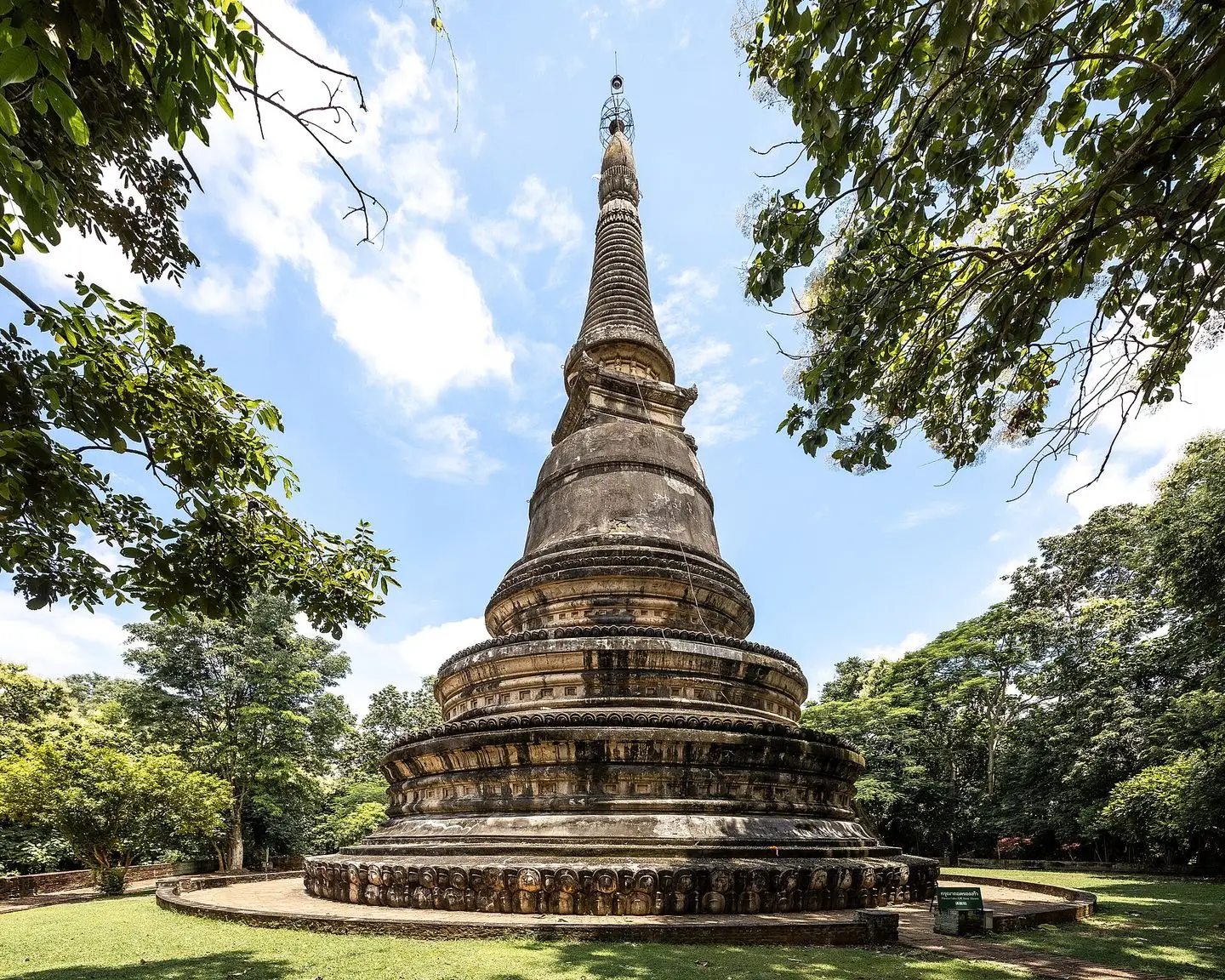
On top of the mound stands the chedi, a bell-shaped early Lanna stupa, grey and weathered, with big trees over it. Climb the steps beside the tunnel entrance and walk round it: no gold leaf, no souvenir stall and, at seven in the morning, no tour group.
The temple stood empty for most of the Burmese centuries. In 1949 a Chiang Mai nobleman, Chao Chuen Sirorot, revived it as a meditation centre in the spirit of Buddhadasa Bhikkhu's forest monastery in the south, and gave it the second half of its name: Suan Phutthatham, the garden of Buddhist teaching. That is where the temple's odd, likeable details come from. Sayings in Thai and English are nailed to the trees along the paths ("All things arise, exist and expire", "Detachment is a way to relax"); people call them the talking trees. There is a field of broken Buddha images among the leaves, a replica of an Ashoka pillar whose sign says thirteenth century and whose historians say a few decades, and at the bottom of the grounds a lake with an island, turtles, big fish and a great many pigeons.
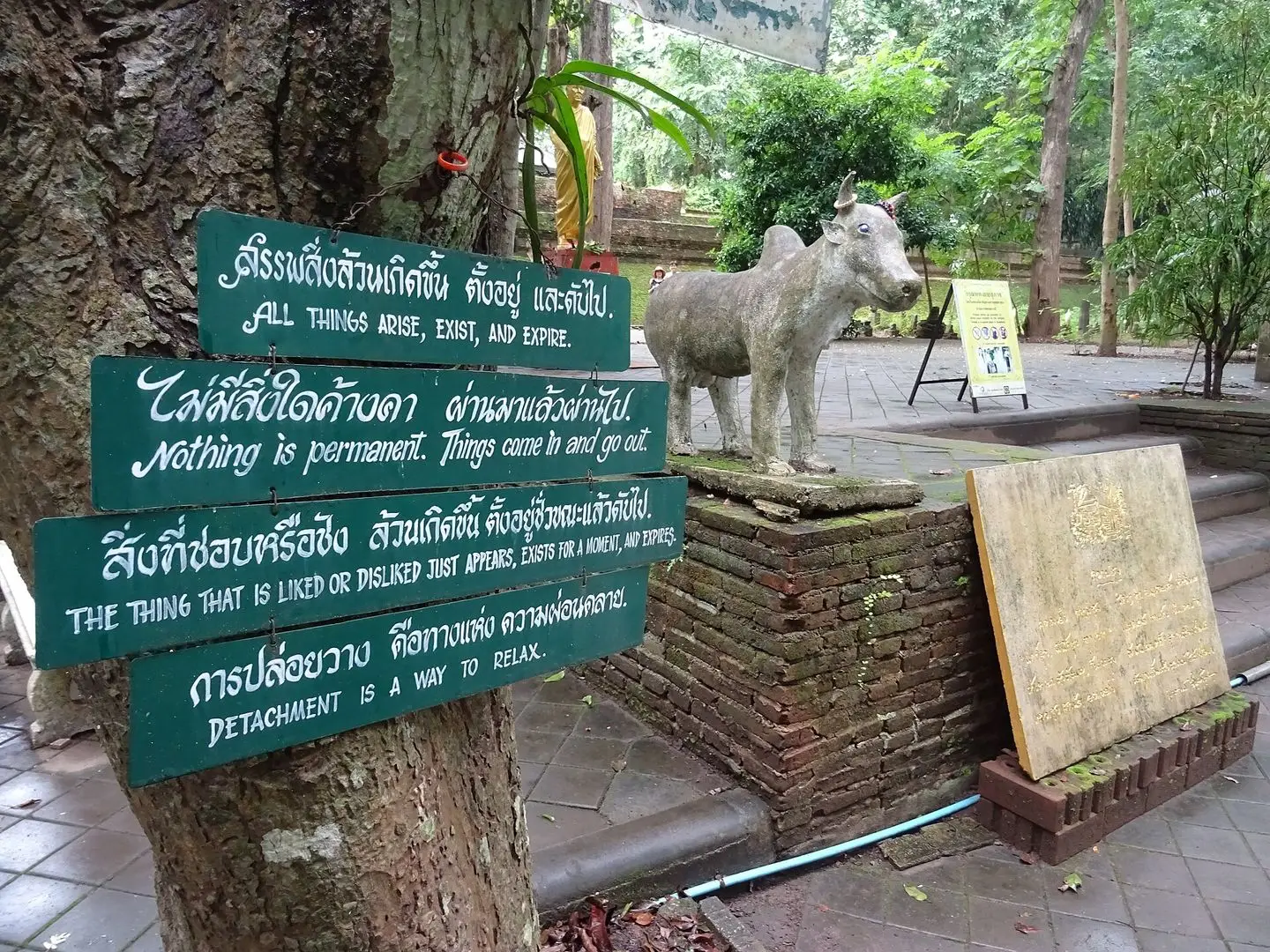
One honest note. In June 2024 the Fine Arts Department restored the temple's stucco giants, four or five hundred years old, by building them up in new plaster until they looked new. A lecturer from the university's fine-arts faculty went public, the governor called it inappropriate, and the department replied that it had followed its standards. The giants are still there, smooth and clean; look at them knowing what you are looking at.
Why bother
Because it is the one temple in Chiang Mai that feels like a forest rather than a courtyard, and the tunnels are strange in a way that photographs do not prepare you for. Half an hour covers the tunnels and the chedi; an hour lets you walk the whole grounds down to the water.
When to go
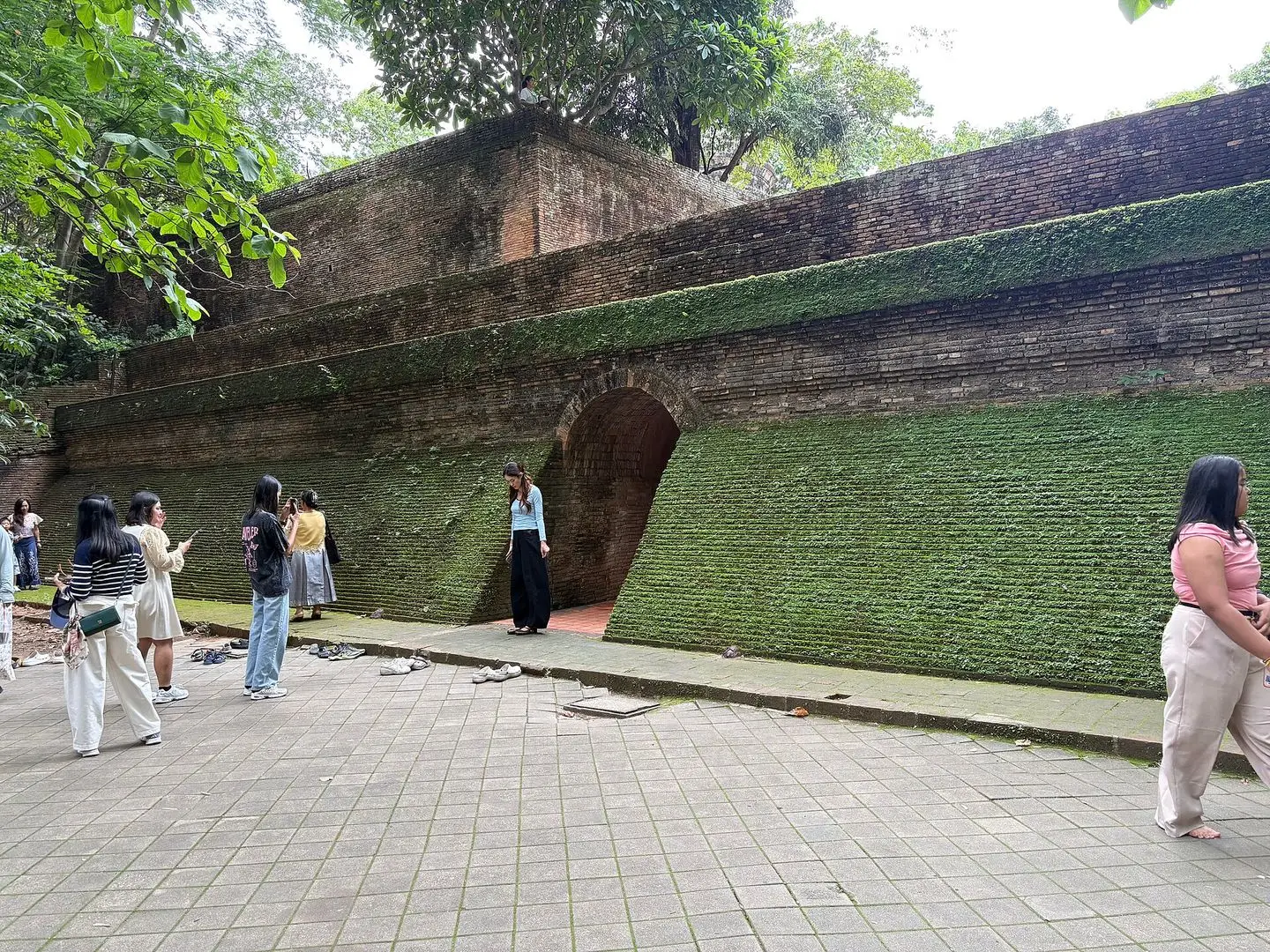
Early. Google Maps lists the grounds as open from 04:00 to 20:00 every day (checked November 2026), so you can be in the tunnels at seven with low light coming through the arches and nobody in front of your camera. By eleven, and on any weekend, the tunnel mouth looks like this:
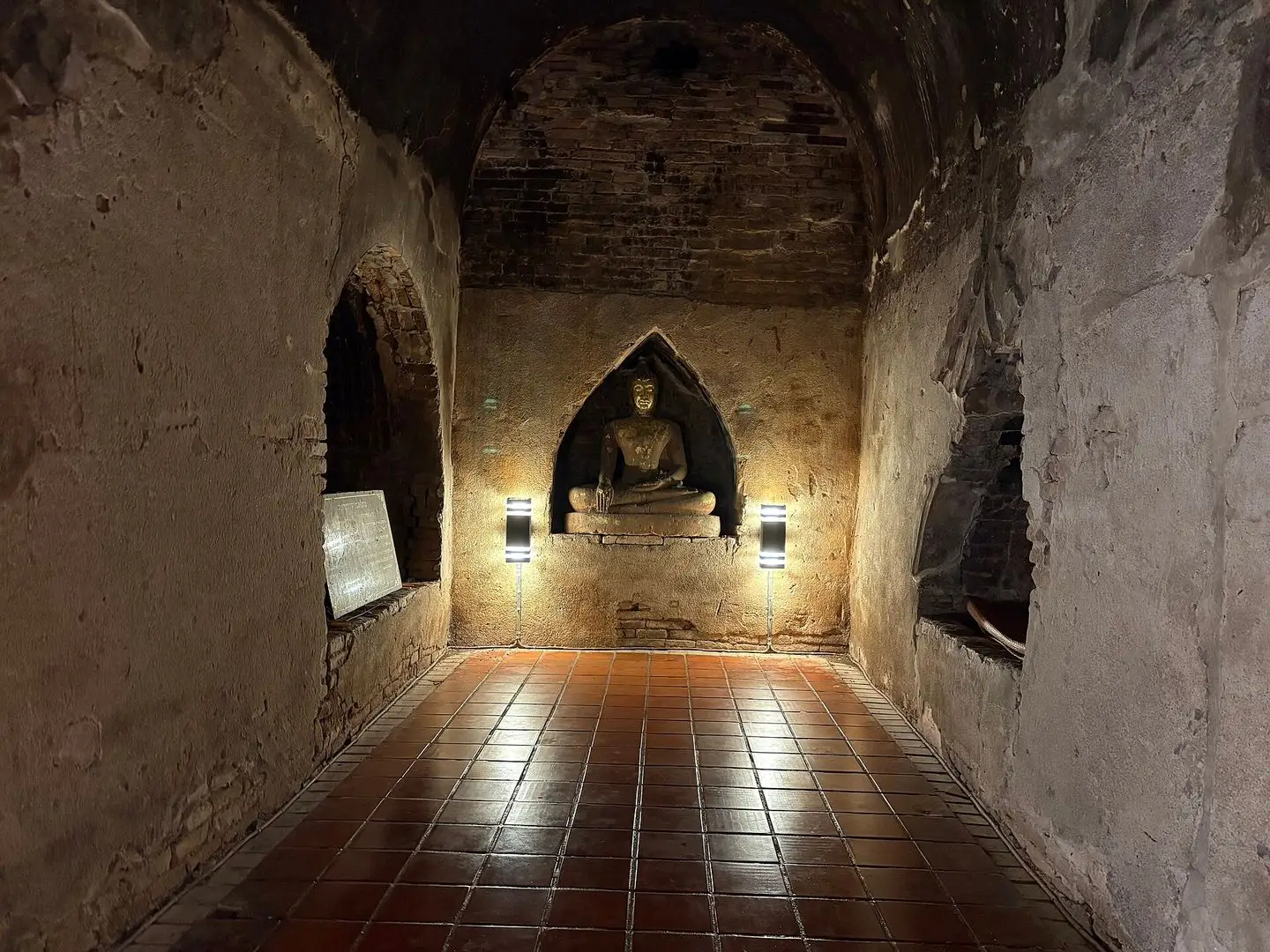
Do the temple first, then ride the 1.5 km to Baan Kang Wat for its 10:00 opening, and you have the order right.
What it costs
Nothing to enter. Donation boxes stand by the tunnels and the chedi, and ฿20 or so in one of them is the custom. Some visitors report a table at the tunnel entrance asking foreigners for a similar sum; others walk straight in. Carry coins either way.
Dress as for any temple, shoulders and knees covered. Shoes come off at the tunnel mouth, and voices come down inside: people meditate in there.
Parking at Wat Umong
Ride in through the gate: the car park is inside the grounds under the trees, and it is free. On a weekend afternoon it fills up and people leave scooters along the lane outside, roadside, the way the locals do.
Baan Kang Wat, the village beside the temple
What it is
The name means "the house beside the temple", and the temple is Wat Ram Poeng, the 1492 monastery next door that has run vipassana retreats since 1975. Baan Kang Wat was the idea of a ceramicist, Nattawut "Big" Ruckprasit of BooKoo Studio: thirteen two- and three-storey houses in teak and brushed concrete, modelled on northern Thai village houses, built around a sunken grass amphitheatre and rented cheaply to craftspeople who could no longer afford the city. He drew the first plans in 2009, broke ground in 2012 and opened a couple of years later.
What you find today is a small, leafy compound of studio-shops: ceramics, prints, textiles, leather, natural soap, a bookshop, a couple of cafés, a kitchen doing khao soi and khanom jeen nam ngiao. Most studios run short workshops (a terrarium in a bottle, a pot on the wheel, a stamped notebook) and the schedule goes up on the village's Facebook page. Some corners are off-limits to cameras and say so; the people here are working, so respect the signs.
Why bother
It is the opposite of Nimman: no chains, no queues, no neon. For an hour it is a very pleasant place to be, and the coffee is good. It is not a full day and it is not a market in the Warorot sense. Thirteen houses is thirteen houses. Think of it as the second half of a morning, not the reason for one.
When to go
Tuesday to Sunday, 10:00 to 18:00, closed on Mondays (Google Maps, checked November 2026; studios keep their own hours inside that, so check Google Maps for today's hours). On a weekday morning a few houses open late and you may be the only visitor; from late morning everything is open. The Sunday morning market, roughly 08:00 to 13:00, fills the amphitheatre with stalls, buskers and food: the liveliest version of the place and the busiest. If your only free day is a Monday, the temple and the cafés are open, and the village is a reason to ride back out on Sunday.
What it costs
Free to walk around. Workshops are priced by each house; ask inside or check the Facebook page. Coffee costs Nimman money.
Parking at Baan Kang Wat
Scooters go on the lane by the entrance with the others. It is roadside and free.
Getting there by scooter
From Nimman. Ride down Nimmanhaemin Road to its end at Suthep Road, about 1.2 km. Turn right, and after 300 m turn left onto Canal Road (Route 121, beside the irrigation canal). Go south for about 850 m to the turn signed to Wat Umong on your right; the lane bends through a quiet neighbourhood for 700 m and ends at the temple gate. About 3 km in all, five to ten minutes.
From the Old Town. Leave the moat on the west side by Suan Dok Gate and follow Suthep Road straight out: past Wat Suan Dok on your right, over the Nimman junction and on to the Canal Road junction. Turn left, then take the same signed right to Wat Umong. About 6 km from Tha Phae Gate, ten to fifteen minutes.
The other way in. Stay on Suthep Road past the canal, and the lane signed to Wat Umong on the left by the university's back gate (Suthep Soi 4) drops south to the same temple.
Between the two. From the temple gate the lane continues south and west for 1.5 km: follow the signs for Wat Ram Poeng and the village is on the road just before the temple. Three minutes.
Suthep Road and Canal Road both see police checkpoints in the mornings. Helmets on both heads, the fine is up to ฿2,000 per person, and carry your licence: riding without one is a ฿500 fine, and the receipt covers you for three days.
The cafés around them
The lanes between the university's back gate and Wat Ram Poeng have more cafés per hundred metres than anywhere in Chiang Mai outside Nimman. They open and close faster than any guide can follow, so we will not list them. The best known is No.39 Cafe, a few minutes from the temple gate, built around a pond with wooden decks over the water; open every day, check Google Maps for today's hours. Baan Kang Wat has its own cafés inside the village for the second coffee.
For a proper breakfast before you ride out, our Old Town breakfast guide has the places that open early.
What to skip
- The midday visit. Wat Umong at noon on a Saturday is a full car park and a queue for the tunnels. Everything that makes the place worthwhile is there at seven.
- A weekday market. There isn't one; the stalls and buskers at Baan Kang Wat are a Sunday morning thing.
Make it a half day
- [Wat Suan Dok](/blog/wat-suan-dok-chiang-mai) is on Suthep Road, a kilometre outside the moat, so you pass it on the way in. The white royal chedis are best in the late afternoon, so make it the last stop.
- [The Monk's Trail to Wat Pha Lat](/blog/monks-trail-chiang-mai) starts 2.3 km from Wat Umong's gate, at the top of the lane beyond the end of Suthep Road. Temple at seven, trailhead by eight, Wat Pha Lat by nine, back at Baan Kang Wat for an early lunch. The national park has charged ฿100 at the trailhead since October 2025.
- Wat Phra That Doi Kham is 6 km south of Baan Kang Wat on a hill above Mae Hia: a 17 m seated Buddha, a viewing platform over the whole city, and the Chiang Mai habit of promising jasmine garlands to the Luang Pho Than Jai image in return for a wish. Free, car park at the top, check Google Maps for today's hours, and go for the last hour of light.
- Royal Park Rajapruek is the longer add-on: 8 km from Baan Kang Wat, the 2006 flower-expo park with the golden royal pavilion. ฿200 for foreign adults (2025 price), open 08:00 to 18:00, last entry 17:00, and it wants two hours and a hat.
Which bike
Ten minutes on city roads, so the bike will not decide your day: anything we rent does it comfortably, and a Giorno or a Click is fine for the whole half day. If you are carrying on up to Doi Suthep afterwards, an ADV 350, ADV 160 or PCX 160 are all ideal for the climb and the descent. Every rental includes two helmets and the free under-seat bag with a first-aid kit and two rain ponchos. The two-minute finder helps if you are undecided.
For the rest of the city and the mountain, see our guide to the best things to do in Chiang Mai.
Quick questions
Is Wat Umong free to visit?
Yes. There is no ticket for the grounds; donation boxes stand by the tunnels and the chedi, and ฿20 or so is the custom. Some visitors report a table at the tunnel entrance asking foreigners for a small sum, so carry coins. The meditation centre is a separate matter and takes residents only by arrangement.
What time does Wat Umong open?
Google Maps lists the grounds as open 04:00 to 20:00 every day (checked November 2026). Early morning, between about 06:30 and 08:00, is the time to go: low light in the tunnels and almost nobody there. By late morning and at weekends it is busy.
Is Baan Kang Wat open on Monday?
No. The village is closed on Mondays and open Tuesday to Sunday, 10:00 to 18:00 (Google Maps, November 2026). Individual studios keep their own hours inside that, and public holidays can change things, so check Google Maps or the village's Facebook page on the day.
When is the Baan Kang Wat market?
Sunday mornings, roughly 08:00 to 13:00, with stalls in the sunken amphitheatre, buskers and food. Some guides mention Saturday as well; the Sunday market is the one we can vouch for. On a weekday there is no market, only the studios.
How far is Wat Umong from Nimman and the Old Town?
About 3 km from One Nimman (five to ten minutes on a scooter) and about 6 km from Tha Phae Gate (ten to fifteen minutes). Baan Kang Wat is 1.5 km beyond the temple, three minutes more.
What should I wear at Wat Umong?
As at any temple: shoulders and knees covered. Shoes come off at the tunnel entrance, and voices come down inside, because people meditate in there. The grounds are a forest, so a mosquito repellent is useful in the rainy months.